


Table of Contents
- Why Thinning Hair Needs a Gentle Hair Care Routine
- Mechanical Damage vs. Hormonal Hair Loss: Know the Difference
- Step 1: Choose a Gentle Shampoo for Thinning Hair
- Step 2: Wash and Detangle Without Breaking Fragile Strands
- Step 3: Dry and Style With Heat Protection and Root Lift
- Step 4: Build Volume With Leave-In Treatments and Scalp Serums
- Collagen Benefits for Hair Growth: Support From the Inside
- How to Stop Hair Thinning Naturally With Daily Habits
- Common Mistakes That Worsen Thinning Hair
- Frequently Asked Questions
Last Updated: October 2, 2026
Why Thinning Hair Needs a Gentle Hair Care Routine
Thinning hair changes the rules of washing and styling. Strands grow finer, density drops, and everything you do at the sink either protects what's left or speeds up the loss. A best gentle hair care routine for thinning hair is not about buying more products, it is about removing the daily habits that snap fragile strands before they reach full length.
Much of that loss is mechanical damage from years of rough towel drying, tight ponytails, and harsh sulfates.
Most guides jump straight to serums and supplements without fixing the wash-day routine first. If you are still scrubbing your scalp with hot water and ripping a brush through wet hair, no product will outrun that damage.
Mechanical Damage vs. Hormonal Hair Loss: Know the Difference
These two problems look identical in the mirror but need different responses. Mechanical damage is physical: friction, heat, tension, and chemical processing that wear down the hair shaft. Hormonal hair loss comes from inside the body, often tied to thyroid changes, menopause, or androgenetic alopecia.
A simple way to tell them apart:
- Mechanical damage: breakage along the length, split ends, frizz, strands that snap mid-shaft
- Hormonal loss: thinning at the crown or part line, more shedding than usual, a wider part
If your hair is breaking off, a gentle routine fixes most of it. If it is falling out from the root, see a dermatologist. The American Academy of Dermatology's guidance on hair loss recommends an evaluation when shedding is sudden or widespread.
Many people have both at once, which is why a gentle routine helps either way.
Step 1: Choose a Gentle Shampoo for Thinning Hair
Start with the cleanser, because it touches your scalp more than anything else you own. A gentle shampoo for thinning hair should clean without stripping natural oils and never leave your scalp tight or itchy.
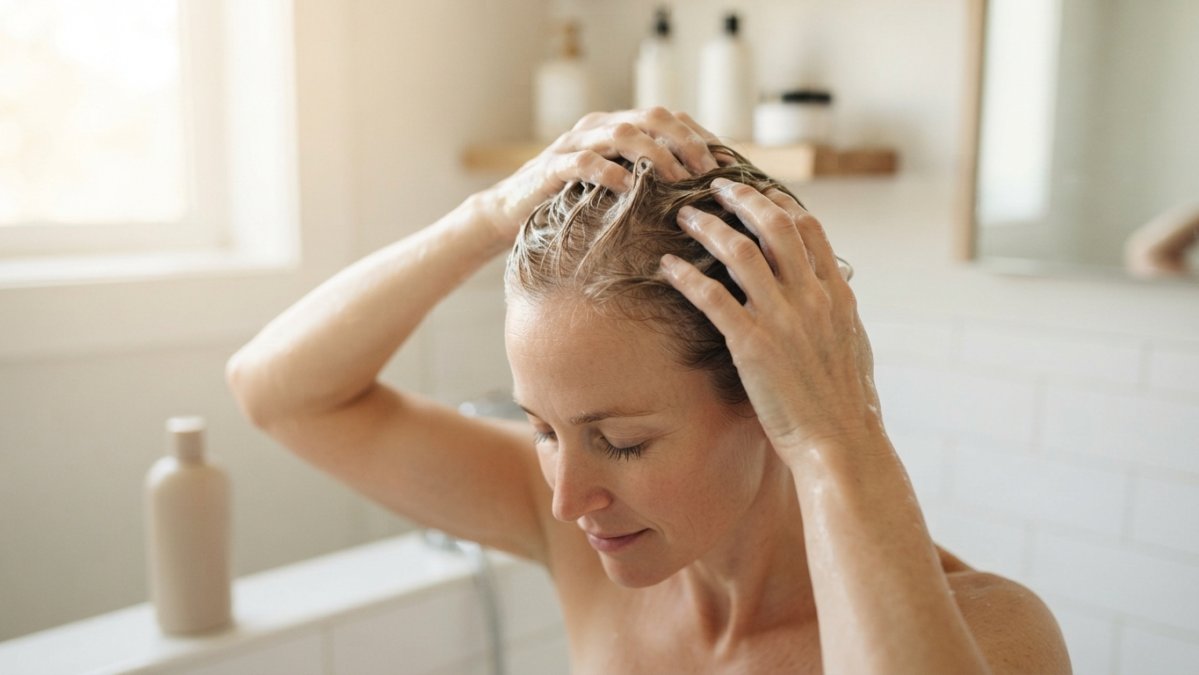
Sulfate-Free and Paraben-Free: What to Look For
Sulfates are the detergents that create rich lather and leave fine hair dry and brittle; parabens are preservatives some people prefer to avoid. Neither belongs in a routine built for fragile strands.
Check the label for these:
- Sulfate-free: no sodium lauryl sulfate or sodium laureth sulfate
- Paraben-free: no methylparaben or propylparaben
- pH balance: a mild, scalp-friendly formula near skin's natural pH
- No heavy silicones that coat and weigh down fine hair texture
A common mistake is buying a "volumizing" shampoo that is really a harsh clarifying formula. Volume means nothing if the strands break.
Step 2: Wash and Detangle Without Breaking Fragile Strands
Water is when hair is weakest, wet strands stretch and snap far more easily than dry ones. Slow down, use lukewarm water, and treat detangling as its own step.
Post-Wash Detangling Techniques That Protect the Hair Shaft
The right order protects the hair cuticle and cuts breakage dramatically. Most people brush too early, too hard, or with the wrong tool.
Try this sequence:
- Apply a leave-in conditioner to wet ends before any combing
- Use a wide-tooth comb, never a fine brush
- Start at the ends and work upward in small sections
- Hold the hair above the tangle so you pull on your hand, not your scalp
- Never comb from the roots down in one stroke
Step 3: Dry and Style With Heat Protection and Root Lift
Heat is the second-biggest cause of breakage after rough detangling. Every pass of a hot tool weakens the hair shaft, and fine hair has less structure to lose. The fix is not quitting styling.
Switch to a microfiber towel or soft cotton t-shirt to blot water out; terry towels roughen the cuticle and cause frizz.
For styling, aim for root lift instead of volume through the lengths:
- Use the lowest heat setting that still works
- Always apply a heat protection spray first
- Point the dryer downward to smooth the cuticle, not upward to rough it
- Lift at the roots with a round brush for fullness where it shows
- Skip tight ponytails and buns that pull on the thinning crown
Step 4: Build Volume With Leave-In Treatments and Scalp Serums
Leave-ins and serums add the most value per drop because they stay on the hair instead of rinsing away, and they let you skip heavy conditioners that flatten fine hair.
Leave-In Conditioners: What Actually Helps Fine Hair
A leave-in conditioner's job is to smooth the cuticle and add slip so you can detangle without snapping strands.
Look for:
- Hydrolyzed proteins (wheat, rice, silk, or keratin), small enough to temporarily fill gaps in the hair shaft, making strands feel thicker and resist breakage. Not permanent repair, but protection between washes.
- Panthenol (provitamin B5), attracts moisture and adds a light coating that improves combability without weight.
- Glycerin or hyaluronic acid, humectants that pull water into the hair. Useful in humid climates; can feel sticky in very dry air.
- Silicones like amodimethicone or dimethicone, a light, water-soluble silicone (PEG- or amodimethicone) reduces friction and breakage on fine hair. Heavy, non-soluble silicones (like cetyl dimethicone) build up and flatten roots.
Skip leave-ins that list heavy oils (coconut, castor, shea) near the top of the ingredient list.
Application rule: mid-shaft to ends only. Never the scalp. A pea-sized amount for shoulder-length hair is plenty.
Scalp Serums: Ingredients With Evidence Behind Them
Scalp serums are where the marketing gets loudest. Here is what the ingredient list should actually contain if you want more than a pleasant tingle.
- Minoxidil, the only topical ingredient with FDA approval for androgenetic alopecia, available over the counter at 2% (often marketed to women) and 5% (often marketed to men). It requires consistent daily use for at least 3 to 6 months before you can judge results, and shedding often increases in the first few weeks as the growth cycle resets. If you are pregnant, nursing, or have a scalp condition, talk to a dermatologist first.
- Ketoconazole, an antifungal in some medicated shampoos (typically 1% over the counter, 2% by prescription), used for dandruff and seborrheic dermatitis, both of which can worsen shedding. Some research suggests a mild anti-androgenic effect on the scalp.
- Caffeine, lab studies show it can counteract DHT on hair follicles, but topical absorption through the scalp is limited and human trial evidence is modest. A reasonable add-on, not a replacement for minoxidil.
- Niacinamide (vitamin B3), supports the scalp barrier and can reduce inflammation. Gentle enough for most sensitive scalps.
- Peptides (copper peptides, biotinoyl tripeptide-1), marketed for follicle support. Evidence is preliminary, but generally well tolerated and non-irritating.
- Rosemary oil, one small trial compared it to 2% minoxidil and found similar hair count improvements over six months. Not a substitute for minoxidil, but a low-risk option for people avoiding medication. Dilute it in a carrier oil; undiluted essential oil can irritate the scalp.
Scalp Massage and Exfoliation: The Free Steps
Two minutes of fingertip massage (not fingernails) during shampoo or before bed increases blood flow to the follicle and distributes your scalp's natural oils. Small studies suggest it may improve hair thickness, though the evidence is not strong enough to call it a treatment.
Wild-Caught Marine Collagen Peptides →
Scalp exfoliation every one to two weeks clears dead skin, product buildup, and excess oil that can clog the follicle opening.
How to Layer Without Weighing Hair Down
The order that works for most fine-haired people:
- Shampoo and condition as usual, rinse well.
- Apply leave-in conditioner to damp mid-lengths and ends.
- Comb through with a wide-tooth comb, ends first.
- Apply scalp serum directly to the scalp along the part line and any thinning areas, then massage in.
- Style as usual. Do not apply heat directly to a wet scalp serum.
If your roots look greasy by mid-morning, you are using too much product or applying it too close to the scalp. Cut the amount in half before you cut the product.
Collagen Benefits for Hair Growth: Support From the Inside
Your routine handles the outside; what you eat and drink handles the inside, and that is where collagen benefits for hair growth come in. Collagen supports skin elasticity and the structures around the hair follicle, and as natural levels drop with age, hair and nails often show it first. Hair is built from protein, so a low-protein diet can push more strands into the resting phase of the hair growth cycle, meaning more shedding weeks later.
This is where a daily collagen powder fits neatly into the routine. Healthy Living Proteins makes a Wild-Caught Marine Collagen Peptides powder that is odorless and flavorless, so it mixes into coffee or a smoothie without changing the taste. Marine collagen absorbs faster than bovine; ideal for skin, hair, and nail support.

How to Stop Hair Thinning Naturally With Daily Habits
Most guides stop at the shower, but the hours you spend asleep and the food you eat shape your hair as much as the shampoo you choose. No topical product can outrun poor sleep, low protein, or a cotton pillowcase grinding against fragile strands for eight hours a night.
Sleep, Pillowcases, and Friction Damage
Your hair spends roughly a third of your life pressed against a pillowcase, thousands of hours of friction, one of the most underrated causes of breakage in thinning hair.
If you do not want to replace your pillowcase, a silk or satin sleep bonnet or a loose braid secured with a soft fabric tie does most of the same job.
Sleep quality matters too. The body repairs tissue, including hair follicles, during deep sleep.
Dietary Support: What Hair Actually Needs
Roughly 80 to 90 percent of a hair strand is keratin, a protein. If your diet is low in protein, your body prioritizes vital organs and pushes hair into the resting phase of the growth cycle, meaning more shedding two to three months later. This is why crash diets often trigger a shed.
A few nutrients matter most for hair:
- Protein, aim for a palm-sized portion at every meal. Eggs, fish, poultry, Greek yogurt, beans, and lentils all count. Most adults need roughly 0.8 grams per kilogram of body weight daily, and more if you are active or over 60.
- Iron, low ferritin (stored iron) is one of the most common and most missed causes of shedding in women, especially those who menstruate. Symptoms include fatigue, cold hands, and brittle nails alongside the hair loss. Ask your doctor for a ferritin test; do not supplement iron without one, because too much iron is harmful.
- Vitamin D, low levels are common in northern climates and in people who spend most of the day indoors. Vitamin D plays a role in the hair growth cycle, and deficiency is associated with shedding.
- Zinc, supports follicle function and scalp health. Oysters, beef, pumpkin seeds, and chickpeas are good sources. Deficiency is rare in people who eat a varied diet, and too much zinc can interfere with copper absorption.
- Biotin, widely marketed for hair, but true deficiency is rare. Supplementing helps only if you are actually deficient. If you take biotin, tell your doctor before any lab work, because it can skew thyroid and cardiac test results.
- Omega-3 fatty acids, support scalp health and may reduce inflammation. Fatty fish (salmon, sardines), walnuts, and flaxseed are good sources.
- Collagen, supports skin elasticity and the connective tissue around the follicle. As natural collagen production declines with age, hair and nails often show it first. Hydrolyzed collagen peptides are broken into small enough fragments to be absorbed, and many people find them easy to add to coffee, tea, or a smoothie.
Stress, Hormones, and the Shedding Lag
Stress pushes hair into the resting phase, but the shed does not happen immediately.
If you can trace a shed back to a surgery, illness, major life stressor, or rapid weight loss about three months prior, that is a strong clue.
Hormonal shifts, pregnancy, postpartum, perimenopause, menopause, thyroid changes, follow their own timelines and often need a doctor's input.
A Simple Daily Checklist
- Silk or satin pillowcase, or a loose braid with a soft tie
- 7 to 9 hours of sleep
- Protein at every meal
- A collagen peptide or protein source you will actually use daily
- Iron, vitamin D, and ferritin checked if shedding continues past a few months
- Stress management that fits your life, walking, breathing, therapy, whatever works
- No tight styles, no harsh brushing, no skipping meals
None of this replaces a dermatologist if your part is widening fast or you are losing hair in patches. But for the slow, steady thinning most people notice in their 30s and 40s, these habits are the inside half of the routine, the half most guides never mention.
Common Mistakes That Worsen Thinning Hair
Most damage comes from a short list of habits that feel harmless.
| Mistake | What It Does | The Fix |
|---|---|---|
| Hot water and harsh sulfates | Strips oils, dries the hair shaft | Lukewarm water, sulfate-free shampoo |
| Brushing wet hair from the roots | Snaps fragile strands mid-shaft | Wide-tooth comb, ends first |
| Rubbing with a terry towel | Roughens the cuticle, causes frizz | Microfiber towel, blot only |
| High heat with no protection | Weakens hair elasticity | Low heat plus heat protection spray |
| Tight ponytails and buns | Pulls on the thinning crown | Loose styles, soft ties |
| Skipping protein and collagen | Starves the follicle of building blocks | Daily protein and collagen support |
Every one of these mistakes speeds up breakage prevention problems you could avoid for free.
Many people also wait too long to see a professional.
Where a gentle routine does its best work is in the everyday.
Thinning hair is a slow problem, and it rewards a slow, steady answer.
Frequently Asked Questions
What is the best hair care routine for thinning hair?
A gentle routine for thinning hair starts with a sulfate-free shampoo, washing only two to three times a week with lukewarm water. Follow with a lightweight conditioner applied mid-shaft to ends, then detangle damp hair with a wide-tooth comb. Air-dry or use a microfiber towel, apply heat protection before styling, and finish with a scalp serum. Add collagen peptides daily to support hair elasticity and density from within.
How does collagen supplementation support hair health?
Collagen provides amino acids like glycine and proline that support the hair shaft and scalp environment. Hydrolyzed collagen peptides are broken into small molecules for easier absorption. A daily serving of multi collagen peptides, such as Healthy Living Proteins' Multi Collagen Peptides Types (I, II, III, V, X) at $44.99, delivers all five types your body uses for skin, hair, and nail support.
Can gentle styling techniques prevent further hair breakage?
Yes. Avoiding tight ponytails, skipping harsh brushes on wet hair, and using heat tools on low settings with protection spray all reduce mechanical damage. A microfiber towel or cotton T-shirt for drying cuts friction. These gentle hair care habits help fragile strands stay intact, which matters most when hair density is already low. Pair them with a sulfate-free wash routine and regular scalp massage.
What should you avoid doing when your hair is thinning?
Skip harsh sulfates, parabens, and alcohol-heavy styling products that strip moisture balance. Avoid vigorous towel drying, brushing wet hair from root to tip, and daily heat styling without protection. Tight hairstyles and chemical treatments can worsen breakage. Also avoid assuming all thinning is the same; hormonal hair loss differs from mechanical damage, so a doctor can help identify the cause before you commit to a routine.