


Table of Contents
- What Is Hydrolyzed Collagen and Why It Matters for Digestive Comfort
- Why Collagen Side Effects Like Bloating Happen
- Collagen Protein Powder Ingredients to Avoid for Sensitive Stomachs
- How to Take Collagen Without Stomach Pain: A Step-by-Step Approach
- Choosing a Gut-Friendly Collagen: What to Look For
- The Role of Collagen Types and Formulation in Digestive Health
- Real Results: What You Can Actually Expect
- Conclusion
Last Updated: August 8, 2026
What Is Hydrolyzed Collagen and Why It Matters for Digestive Comfort
Hydrolyzed collagen is collagen protein broken down into smaller peptides through hydrolysis, making it easier for your digestive system to absorb. This differs from whole collagen because the smaller molecular size allows your gut to process it with minimal stress.
The hydrolysis process creates collagen peptides, short chains of amino acids your body can use immediately. With a sensitive stomach, this matters tremendously. Whole collagen sits in your digestive tract longer, potentially triggering bloating, gas, or discomfort. Hydrolyzed collagen peptides move through more quickly and efficiently.

Your body uses these amino acids to rebuild connective tissue, support skin elasticity, strengthen hair and nails, and maintain gut lining integrity. Collagen is especially rich in glycine and proline, which your digestive system specifically needs to repair itself. For people dealing with digestive distress, this targeted nutrient delivery makes a real difference.
The catch: not all hydrolyzed collagen is created equal. Sourcing, processing, and additives all matter. Choosing the right collagen supplement for sensitive stomachs requires understanding what you're actually buying.
Why Collagen Side Effects Like Bloating Happen
Most collagen side effects stem from three causes: the supplement itself, how you're taking it, or what's mixed into the formula.
The first culprit is additives. Many collagen products contain gelling agents, artificial sweeteners, or thickeners that sensitive stomachs can't tolerate. Xanthan gum, maltodextrin, and certain sugar alcohols trigger gut bacteria to produce excess gas, leading to bloating within hours.
The second issue is dosage timing. Taking a full serving on an empty stomach or all at once can overwhelm your digestive system, even with high-quality collagen. Your stomach acid and intestines need time to absorb. Rush it, and you get fermentation and gas.
The third reason is interactions with your existing gut environment. If you have low stomach acid, insufficient digestive enzymes, or an imbalanced microbiome, even pure hydrolyzed collagen peptides can cause discomfort. This is especially true for people with IBS or acid reflux issues.
Collagen side effects aren't a sign that collagen is bad for you, they're usually a sign that the formula, timing, or dose isn't right for your specific digestive situation. The solution is to approach it strategically.
Collagen Protein Powder Ingredients to Avoid for Sensitive Stomachs
Before buying any collagen supplement, scan the ingredient label for these common triggers.
Gelling agents and thickeners. Xanthan gum, guar gum, and carrageenan improve texture but are inflammatory triggers for sensitive stomachs. They ferment in your lower intestine, creating bloating and gas.
Artificial sweeteners. Sucralose, aspartame, and acesulfame potassium alter your microbiome balance and trigger digestive distress. Sugar alcohols like sorbitol and xylitol are slightly better but still problematic for many.
Fillers and flow agents. Silicon dioxide, magnesium stearate, and cellulose serve no nutritional purpose and can accumulate in your digestive tract with daily use.
Soy lecithin and emulsifiers. These help oil and water mix but can trigger bloating and loose stools in sensitive individuals.
Artificial flavoring. Both artificial and natural flavoring can contain compounds that irritate a sensitive gut lining.
What to look for instead: A clean collagen supplement should have just a few ingredients, hydrolyzed collagen peptides, vitamin C for collagen synthesis, and possibly probiotics for gut support. Organic, non-GMO, and dairy-free are reliable markers that the brand has considered digestive tolerance.
Healthy Living Proteins' Multi Collagen Peptides & Colostrum formula is specifically designed with sensitive stomachs in mind. It contains all five collagen types with grass-fed colostrum and probiotics, but crucially, it avoids additives that trigger bloating and digestive distress.
How to Take Collagen Without Stomach Pain: A Step-by-Step Approach
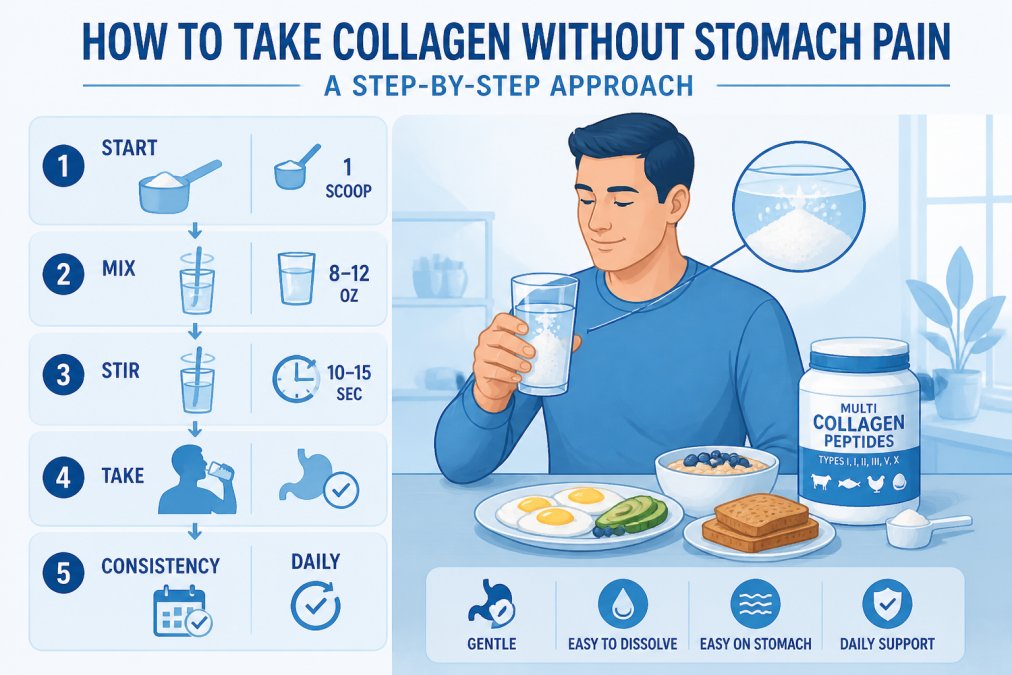
Taking collagen correctly is half the battle. Even a high-quality supplement will cause discomfort if you dose it wrong.
Start with a lower dose
Begin with half a serving, typically 5-7 grams instead of the standard 10-15 grams. Your digestive system needs time to adapt to processing collagen peptides. Take this reduced dose for 3-5 days, monitoring how you feel. If you experience no bloating or stomach pain, increase to three-quarters of a serving for another week. Only after two weeks of tolerance should you move to the full recommended dose.
This gradual approach prevents bloating and discomfort by giving your gut time to adjust.
Take it with food and digestive support
Never take collagen on an empty stomach if you have a sensitive stomach. Food slows digestion and gives your stomach acid and digestive enzymes time to work properly. Eat a meal with protein, fat, and carbohydrates first, then take your collagen.
Consider pairing your collagen with a digestive enzyme supplement. Enzymes like protease and amylase break down protein more efficiently, reducing the load on your digestive system. This is especially helpful if you have low stomach acid or enzyme deficiencies.
Space out your intake
If taking collagen daily, split your dose. Instead of 10-15 grams once a day, take 5-7 grams twice a day with different meals. This spreads the protein load across your digestive system and reduces fermentation and gas. Spacing also improves absorption, your intestines can only absorb a certain amount of amino acids at once.
| Dosage Approach | Duration | Expected Outcome |
|---|---|---|
| Start: Half serving (5-7g) | 3-5 days | Assess tolerance, zero bloating |
| Increase: Three-quarters serving | 1 week | Monitor comfort, no digestive distress |
| Full dose: 10-15g daily | Ongoing | Stable absorption, sustained results |
| Split dosing: 5-7g twice daily | Ongoing | Reduced bloating, better absorption |
Choosing a Gut-Friendly Collagen: What to Look For
Not all collagen supplements are created equal. A truly gut-friendly formula requires specific sourcing, processing standards, and ingredient choices.
Hydrolysis process matters. Cold hydrolysis and enzymatic hydrolysis preserve more amino acid integrity than high-heat methods.
Bioavailability is the real measure. Bioavailability means how much of the collagen your body can actually absorb and use. Look for brands that mention molecular weight or peptide size; smaller peptides mean higher bioavailability and better results with smaller doses.
Sourcing and purity standards. Grass-fed bovine collagen is superior to grain-fed because it has better amino acid profiles and fewer inflammatory compounds.
The collagen type matters. Type I supports skin, hair, and nails. Type II supports joint cartilage and gut lining. Type III supports skin elasticity and blood vessel integrity. A formula with all five collagen types gives your body everything it needs for comprehensive support.
Probiotics and digestive support are a plus. A truly gut-friendly formula includes probiotics that support microbiome balance. Lactobacillus and Bifidobacterium strains help your digestive system tolerate protein supplements better. Colostrum adds immunoglobulins that strengthen gut lining integrity.
Avoid unnecessary additives. The fewer ingredients beyond the collagen itself, the better. Organic certification, non-GMO verification, and dairy-free status indicate the brand has considered digestive tolerance.
Healthy Living Proteins checks every box. The Multi Collagen Peptides & Colostrum formula contains all five collagen types with grass-fed colostrum, probiotics, and vitamin C for collagen synthesis, but nothing that triggers bloating or digestive distress. At $49.99 per container, it's a premium option, but the formula justifies the price. The 30-day money-back guarantee reflects a brand that stands behind their product.

The Role of Collagen Types and Formulation in Digestive Health
Understanding collagen types helps you understand why some formulas work better for sensitive stomachs.
Type I collagen is the most abundant in your body and the primary structural protein in skin, hair, nails, and connective tissue. For digestive health, Type I provides amino acids your gut lining needs to repair and rebuild.
Type III collagen works alongside Type I to support skin elasticity and blood vessel integrity. It's especially important for people with acid reflux because it strengthens tissues around your esophagus and stomach.
Type II collagen supports cartilage and joint health. While not directly related to digestion, joint health and gut health are connected through inflammation markers.
Types IV and V collagen are less abundant but crucial for basement membrane integrity and connective tissue support throughout your digestive tract.
A formula with all five types gives your digestive system everything it needs to repair itself at every level. Your gut lining is a complex structure with multiple layers that benefit from comprehensive collagen support.
A formula that includes colostrum adds immunoglobulins that directly support gut barrier function. Colostrum contains IgA, IgG, and lactoferrin, which strengthen your intestinal lining and reduce permeability. This is especially valuable for leaky gut concerns or IBS sensitivities.
Probiotics in the formula help your microbiome process collagen more efficiently and reduce fermentation that causes bloating. The right probiotic strains can also reduce inflammation in your digestive tract and improve acid reflux symptoms.
Real Results: What You Can Actually Expect
Collagen supplements work, but not overnight. Realistic expectations matter because disappointment leads people to quit before they see results.
Week 1-2: Tolerance and adaptation. Your digestive system adjusts to processing collagen peptides. You might notice reduced bloating. Digestive symptoms should stabilize.
Week 3-4: Subtle changes. Your skin might feel slightly more hydrated. Hair and nails might feel stronger. Joint stiffness might ease slightly.
Week 6-8: Noticeable differences. Skin looks clearer and more radiant. Hair feels thicker. Nails are stronger. Joint mobility improves. Digestive comfort is noticeably better with less bloating and fewer acid reflux episodes.
Week 12+: Sustained benefits. After three months of consistent use, benefits compound. Your body has rebuilt significant amounts of collagen in your skin, joints, and gut lining.
The timeline varies based on your age, current health status, and consistency. Consistency matters more than dosage, taking your collagen every day for eight weeks delivers better results than taking double doses sporadically. This reinforces the importance of the gradual dosing approach discussed earlier.
Collagen supplements for sensitive stomachs are genuinely effective when you choose the right formula and take it strategically. The key is starting low, avoiding additives that trigger bloating, and giving your digestive system time to adapt. Healthy Living Proteins' Multi Collagen Peptides & Colostrum combines all five collagen types with probiotics and colostrum specifically to support digestive comfort while delivering the amino acids your body needs to rebuild skin, hair, nails, and gut lining integrity. Get started with Healthy Living Proteins and experience the difference that a truly gut-friendly collagen formula can make.
Frequently Asked Questions
Which collagen is best for a sensitive stomach?
Hydrolyzed collagen peptides with a molecular weight under 3,000 Daltons are absorbed more easily by sensitive digestive systems. Look for formulas free of artificial sweeteners, gelling agents, and common allergens. Healthy Living Proteins' Multi Collagen Peptides & Colostrum combines all five collagen types with probiotics specifically designed to support gut comfort. Start with a smaller dose (5g) and increase gradually to assess tolerance.
Why does collagen cause bloating and digestive discomfort?
Collagen supplements can trigger bloating when your digestive system isn't accustomed to the amino acid load, especially if you take a large dose on an empty stomach. Additives like sugar alcohols, gelling agents, or excess fiber can worsen gastrointestinal distress. Your microbiome may also need time to adjust to the increased protein intake. Taking collagen with food and digestive enzymes helps your body process it more efficiently.
What ingredients should I avoid in collagen powders if I have IBS or acid reflux?
Avoid artificial sweeteners (especially sugar alcohols like sorbitol), gelling agents, excessive added fiber, and common allergens like dairy or soy. If you have acid reflux, skip formulas with citric acid or high-acid additives. Non-GMO, organic, and dairy-free options are gentler on sensitive stomachs. Check labels for colostrum and probiotics, which support gut lining integrity and reduce inflammation rather than trigger it.
How long does it take to see results from collagen supplements for digestive health?
Most people notice improved digestion within 2-4 weeks of consistent use, though individual timelines vary. Skin, hair, and nail improvements typically take 8-12 weeks because collagen synthesis is slower in these tissues. Start with a lower dose and increase gradually to give your gut time to adapt. If you don't see improvement after 30 days, Healthy Living Proteins offers a 30-day money-back guarantee so you can try it risk-free.
This article was written using GrandRanker