


Table of Contents
- What Is Collagen and Why Your Body Needs It After 25
- Types of Collagen and Their Benefits: What Each One Does
- Hydrolyzed Collagen Peptides: Why Absorption Rate Is Everything
- Marine Collagen vs Bovine Collagen: Which Source Is Right for You
- Collagen Powder Benefits and Side Effects: What to Realistically Expect
- How to Choose Collagen Powder: 7 Quality Markers to Evaluate
- Common Mistakes When Choosing Collagen Powder (And How to Avoid Them)
- Conclusion: Build a Smarter Collagen Routine
Last Updated: August 1, 2026
Knowing how to choose collagen powder is harder than it looks. The supplement aisle is crowded with products that look identical but differ dramatically in quality, absorption, and results. At Healthy Living Proteins, we've guided over 15,000 customers through this decision, and the pattern is clear: the wrong product delivers nothing, while the right one can produce noticeable changes in skin texture, joint comfort, and hair quality within weeks.
Most guides focus on marketing claims instead of the structural factors that determine whether collagen actually works: molecular weight, collagen type, source quality, and third-party verification. This guide covers all of it.
What Is Collagen and Why Your Body Needs It After 25
Collagen is the most abundant structural protein in the human body, forming the primary scaffolding of skin, bone, cartilage, tendons, and connective tissue. Collagen production begins declining noticeably around age 25, accelerating with UV exposure, poor diet, and chronic stress.
Supplementing with collagen powder supplies the amino acids your body needs to rebuild these structures: glycine, proline, and hydroxyproline. According to NIH National Library of Medicine research on collagen supplementation, oral collagen peptides are absorbed through the gastrointestinal tract and transported to target tissues including the skin, where they stimulate fibroblast activity and support collagen synthesis.
Taking any collagen is not the same as taking the right collagen. Source, processing method, and molecular size all determine whether the supplement reaches your target tissues or passes through unabsorbed.
Types of Collagen and Their Benefits: What Each One Does
Different collagen types serve different tissues and functions. Understanding these distinctions is fundamental to choosing collagen powder that matches your goals.
Type I and Type III: Skin, Hair, and Nails
Type I collagen is the most prevalent type in the human body and the primary structural component of the dermis. Type III collagen works alongside Type I and is found in skin, blood vessels, and internal organs. Together, these two types are most relevant for adults concerned with skin hydration, elasticity, hair thickness, and nail strength.
Most single-source collagen powders, particularly bovine-derived ones, are rich in Type I and Type III. The limitation is that they don't address joint or gut health as directly.
Type II: Cartilage Support and Joint Mobility
Type II collagen is the dominant protein in cartilage, the tissue that cushions joints and absorbs impact. This is the type most relevant for adults dealing with joint stiffness or reduced mobility. Chicken-sourced collagen is the most concentrated natural source of Type II.
Adults over 25 experiencing joint discomfort should specifically verify that Type II collagen is present in their supplement.
Types IV and V: Why a Multi-Type Formula Matters
Type IV collagen forms the basal lamina supporting organ and tissue structure, while Type V is found in cell surfaces and hair. A multi-type formula that includes all five collagen types provides broader coverage across skin, joints, connective tissue, and cellular structure.
| Collagen Type | Primary Location | Key Benefit | Best Source |
|---|---|---|---|
| Type I | Dermis, bones, tendons | Skin elasticity, nail strength | Bovine, marine |
| Type II | Cartilage | Joint cushioning, mobility | Chicken sternum |
| Type III | Skin, blood vessels | Skin firmness, wound healing | Bovine |
| Type IV | Basal membranes | Tissue structure support | Multi-type formula |
| Type V | Cell surfaces, hair | Hair health, cellular integrity | Multi-type formula |
Hydrolyzed Collagen Peptides: Why Absorption Rate Is Everything
Raw collagen molecules are too large for direct absorption through the intestinal wall. Hydrolyzed collagen, also called collagen peptides, has been broken down through enzymatic processing into smaller peptide chains that the body can absorb efficiently.
Hydrolyzed collagen peptides are the gold standard form of collagen supplementation because their reduced molecular size allows them to pass through the gut lining and enter systemic circulation. A product that lists "collagen" without specifying hydrolyzed or peptide form may contain intact collagen molecules with significantly lower bioavailability.
Molecular Weight and Daltons: The Science Behind Superior Absorption
Molecular weight, measured in daltons, is the most precise indicator of how well a collagen peptide will absorb. According to peer-reviewed research on collagen peptide bioavailability and molecular weight, low-molecular-weight collagen peptides in the range of 2,000 to 5,000 daltons show superior absorption compared to higher-weight alternatives.
Most quality collagen supplements will specify molecular weight on their packaging or product page. If a brand doesn't disclose this figure, it's reasonable to question whether their hydrolysis process is optimized for absorption.
Marine Collagen vs Bovine Collagen: Which Source Is Right for You
The two dominant collagen sources on the market are bovine and marine, and the choice between them matters more than most buyers realize.
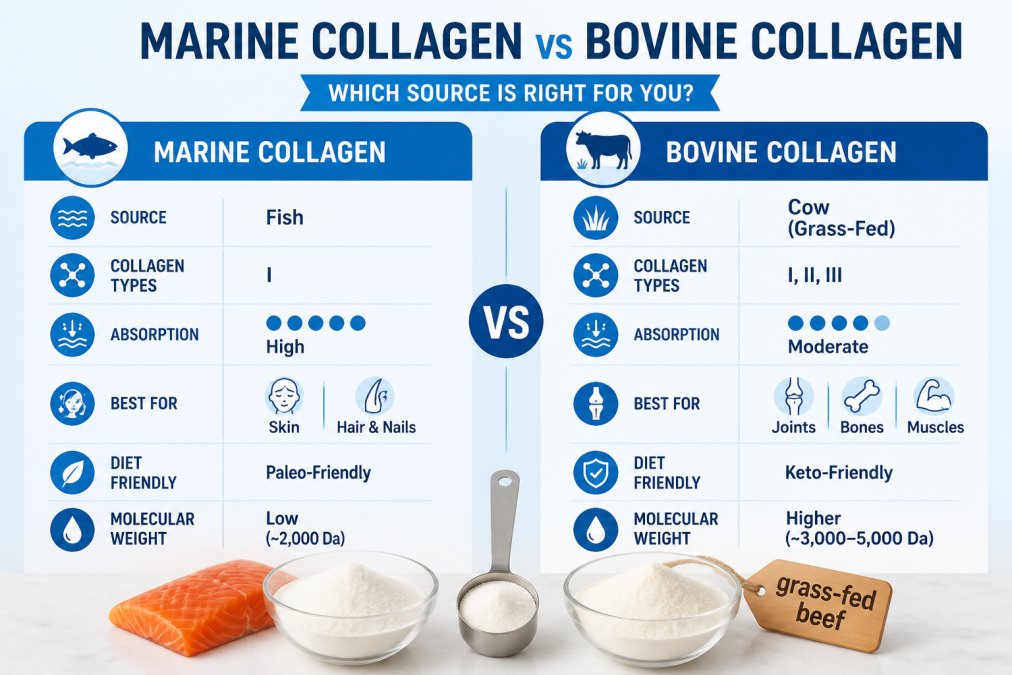
Bovine collagen is derived from the hides and bones of cattle. It's rich in Type I and Type III collagen, making it well-suited for skin, hair, nail, and gut support. Grass-fed bovine collagen is preferred because cattle raised on pasture tend to have lower exposure to antibiotics and hormones.
Marine collagen is sourced from fish skin and scales, typically from wild-caught species. It's almost exclusively Type I collagen and has a smaller average molecular weight compared to bovine collagen, giving it a slight bioavailability advantage for skin-focused applications.
The honest comparison:
- For skin and anti-aging goals: Marine collagen has a slight edge due to molecular size and Type I concentration
- For joint support: Bovine collagen, especially when combined with Type II from chicken, is more comprehensive
- For overall health support: A multi-source formula covering all five types provides the broadest benefit profile
- For dietary restrictions: Marine collagen is unsuitable for those avoiding fish; bovine is unsuitable for those avoiding beef
Collagen Powder Benefits and Side Effects: What to Realistically Expect
Collagen powder benefits are real, but they require realistic timelines. Most people who report no results either chose the wrong type, used an under-dosed product, or stopped too soon.
Realistic outcomes from consistent collagen supplementation include improved skin hydration and elasticity, reduced joint discomfort, stronger nails, and support for gut lining integrity. These changes typically emerge over six to twelve weeks of daily use.
Collagen powder is generally well-tolerated by most adults. Some people with sensitive digestion report mild bloating when starting, which often resolves within a week or two. Those with fish or shellfish allergies should avoid marine collagen entirely.
How to Choose Collagen Powder: 7 Quality Markers to Evaluate
Knowing how to choose collagen powder comes down to evaluating seven specific markers, each of which separates a product worth buying from one that's not.
Third-Party Testing and Certification
Third-party testing is the single most important quality signal for any dietary supplement. Look for certifications from organizations like NSF International, USP, or Informed Sport, which verify that a product contains what its label claims and is free from contaminants.
A brand that doesn't disclose third-party testing status leaves you without independent verification of quality.
Nutrition Label Red Flags: Artificial Fillers and Hidden Additives
The nutrition label tells you more than most buyers check. Artificial fillers, excessive sugar, maltodextrin as a primary ingredient, and proprietary blends that obscure individual dosages are all red flags. A quality collagen powder should list collagen peptides as the first ingredient, followed by any functional additions like vitamin C or probiotics.
Check the protein content per serving. Collagen powder that delivers less than 10 grams of protein per serving may be underdosed for meaningful results.
Synergistic Ingredients That Boost Collagen Synthesis
The right supporting ingredients can significantly amplify the effectiveness of collagen supplementation. Vitamin C is the most evidence-backed addition, as it's a direct cofactor in collagen synthesis. Probiotics support nutrient absorption, including the uptake of collagen peptides. Hyaluronic acid, biotin, and zinc are also commonly included in premium formulas.
Sustainability and Ethical Sourcing: Grass-Fed, Wild-Caught, and Beyond
Grass-fed bovine collagen comes from cattle raised on pasture, which generally means lower exposure to synthetic inputs and a cleaner final product. Wild-caught marine collagen comes from fish harvested from natural ocean environments rather than aquaculture operations.
Look for brands that are transparent about their sourcing geography and animal welfare practices. According to FDA dietary supplement labeling guidance, supplement manufacturers are responsible for ensuring their products are safe and accurately labeled, but sourcing transparency remains a voluntary disclosure.
Common Mistakes When Choosing Collagen Powder (And How to Avoid Them)
Most people make the same handful of mistakes when buying collagen.
Choosing based on price alone. The cheapest collagen powders are often the least processed, meaning larger molecular weight, lower bioavailability, and less effective results.
Ignoring collagen type. Buying a Type I-only product for joint pain, or a Type II-only product for skin goals, is a fundamental mismatch.
Expecting results in days. Meaningful changes to skin, joints, and hair take six to twelve weeks of consistent daily use.
Not checking for third-party testing. Without independent verification, you're trusting the manufacturer's self-reporting entirely.
Overlooking the full formula. A collagen powder that includes colostrum and probiotics alongside hydrolyzed peptides addresses absorption and gut health simultaneously.
Skipping the label check. Two minutes reading the nutrition facts panel is worth the effort.
Committing too fast without a trial option. A 30-day money-back guarantee is a meaningful signal of brand confidence.
Conclusion: Build a Smarter Collagen Routine
Choosing a collagen supplement is genuinely complex, and the market makes it easy to spend money on products that deliver little. The criteria that matter most are hydrolysis method, molecular weight, collagen type coverage, third-party verification, and sourcing transparency.
The challenge isn't finding a collagen powder; it's finding one that's actually formulated to work. Healthy Living Proteins addresses the full picture: a formula containing all five collagen types, hydrolyzed for superior absorption, and supported by colostrum and probiotics for gut health and immune function. The 30-day money-back guarantee means you can verify results before making a longer commitment. For adults over 25 looking to support skin, joints, hair, and overall vitality, get started with Healthy Living Proteins and experience the difference a properly formulated collagen supplement makes.
Frequently Asked Questions
What should I look for when buying collagen powder?
When choosing collagen powder, prioritize products that use hydrolyzed collagen peptides for better absorption, disclose the collagen source (such as grass-fed bovine or wild-caught marine), list all collagen types included, and carry third-party testing verification. Check the nutrition label for artificial fillers, added sugars, and unnecessary binders. A soluble powder with a clean amino acid profile and synergistic ingredients like vitamin C will generally support more effective collagen synthesis.
What type of collagen is best for beginners?
For most beginners, a multi-type collagen powder covering at least types I, II, and III offers the broadest benefit, supporting skin elasticity, cartilage support, and connective tissue health simultaneously. Type I collagen is the most abundant in the human body and is a reliable starting point for skin, hair, and nail goals. If joint stiffness is your primary concern, look for a formula that also includes type II collagen specifically derived from chicken sternum or similar sources.
How do hydrolyzed collagen peptides differ from regular collagen?
Hydrolyzed collagen peptides are collagen proteins that have been broken down into shorter peptide chains through a process called hydrolysis. This reduces their molecular weight, often measured in daltons, making them significantly easier for the digestive system to absorb compared to whole collagen proteins. The smaller the peptide chains, the higher the bioavailability. This is why hydrolyzed collagen is the preferred form in quality dietary supplements and consistently outperforms non-hydrolyzed alternatives in absorption rate.
What are the potential side effects of collagen powder?
Collagen powder is generally well tolerated, but some individuals may experience mild digestive discomfort, bloating, or a feeling of fullness when first starting supplementation. Those with allergies to fish, shellfish, or eggs should carefully verify the collagen source before use. Marine collagen carries a higher risk for people with seafood sensitivities. As with any dietary supplement, it is advisable to consult a qualified healthcare professional before starting, especially if you have existing health conditions or take medications.
Is liquid collagen better than collagen powder?
Neither format is universally superior, both can deliver hydrolyzed collagen peptides effectively when properly formulated. Collagen powder typically offers greater flexibility in dosing, easier storage, and the ability to blend with other synergistic ingredients like probiotics or vitamin C. Liquid collagen is convenient but may contain more preservatives or added sugars to maintain shelf stability. For most adults, a high-quality collagen powder with strong solubility and a clean nutrition label is a practical and cost-effective choice.
How much collagen powder should I take daily?
Research on collagen supplementation commonly examines daily amounts ranging from roughly 2.5 grams to 15 grams, depending on the intended benefit, skin hydration, joint support, or muscle recovery. However, optimal dosing can vary based on individual factors such as age, body weight, and diet. Always follow the serving size guidance on your specific product's nutrition label and consult a healthcare professional if you are unsure what amount is appropriate for your personal health goals.
Does collagen powder actually work for joint pain and stiffness?
Collagen makes up a significant portion of cartilage and connective tissue, and supplementing with hydrolyzed collagen peptides, particularly type II collagen, may help support joint comfort over time. Results are not immediate; consistent daily use over several weeks is typically needed before noticeable changes in mobility or stiffness occur. Collagen powder is not a medical treatment for joint conditions, and anyone experiencing significant or persistent joint pain should seek guidance from a licensed healthcare provider.
This article was written using GrandRanker