


Table of Contents
- What Causes Brittle Nails and How Collagen Helps
- Best Collagen Supplements for Brittle Nails: Top Picks
- How Long Does It Take for Collagen to Work on Nails
- Biotin vs Collagen for Nail Strength: What the Science Shows
- Collagen Supplement Dosage for Nail Growth
- Type I and Type III Collagen: Why These Matter for Nails
- Absorption and Bioavailability: Hydrolyzed vs Non-Hydrolyzed
- Synergistic Nutrients That Boost Collagen Effectiveness
Last Updated: August 10, 2026
What Causes Brittle Nails and How Collagen Helps
Brittle nails, characterized by peeling, splitting, and breakage, signal a deficiency in structural proteins. The best collagen for brittle nails addresses this by replenishing amino acids your nail matrix needs to rebuild strength from within.
Nails depend on collagen for structural integrity alongside keratin. When collagen levels drop from aging, nutritional gaps, or environmental stress, nails lose elasticity and become prone to onychoschizia (peeling and splitting). Collagen supplementation works because it provides bioavailable amino acids, glycine, proline, and hydroxyproline, that your body uses to synthesize new collagen in the nail matrix. Hydrolyzed collagen peptides absorb more efficiently than non-hydrolyzed forms, reaching nails faster and in higher concentrations.

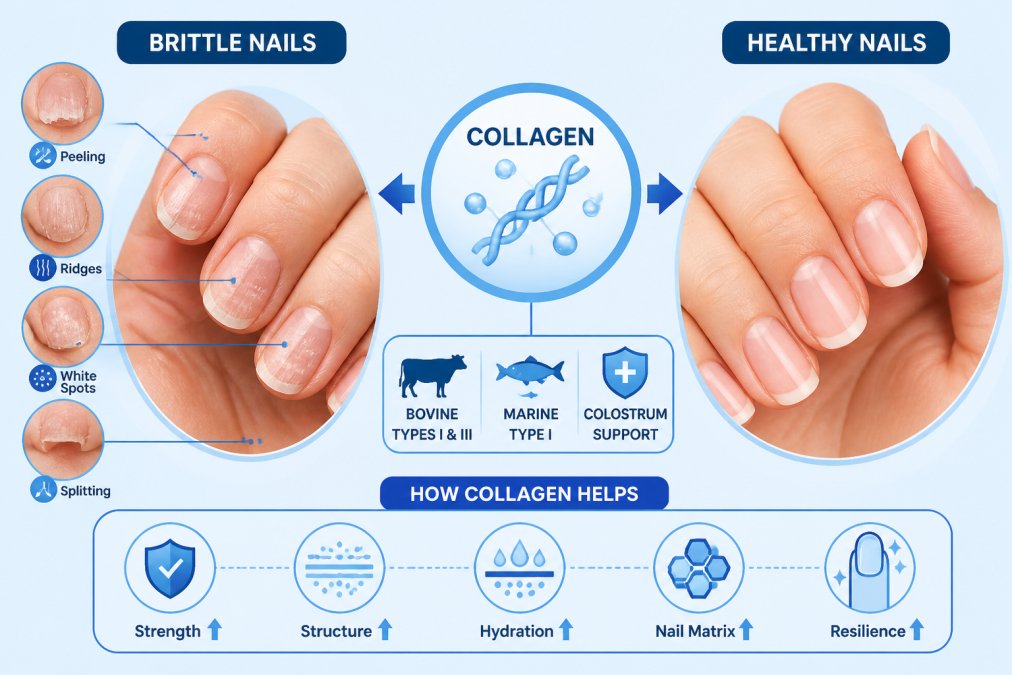
The best collagen for brittle nails depends on your absorption capacity, dietary preferences, and whether you need additional support from synergistic nutrients like biotin or vitamin C.
Best Collagen Supplements for Brittle Nails: Top Picks
Healthy Living Proteins Multi Collagen Peptides & Colostrum
Healthy Living Proteins combines all five collagen types with colostrum and probiotics, designed specifically for absorption and nail strength. At $49.99, it delivers 11 grams of hydrolyzed collagen per serving alongside grass-fed colostrum and clinically studied probiotics that support gut health, directly impacting collagen absorption.
Colostrum strengthens intestinal permeability, allowing hydrolyzed collagen peptides to be absorbed systemically where they reach your nail matrix. The formula includes Type I and III collagen (primary types in nails) alongside Type II (joints), Type V (hair), and Type X (cartilage), supporting your entire collagen network.
Healthy Living Proteins Wild-Caught Marine Collagen Peptides
At $39.99, the Wild-Caught Marine Collagen Peptides is the most bioavailable option for those preferring marine sources. Marine collagen absorbs 1.5 times faster than bovine collagen due to smaller peptide molecular weight. It delivers pure Type I collagen, the dominant type in nails, at 24 grams per serving from sustainable fisheries.
The unflavored format mixes into any beverage without altering taste. One limitation: it lacks synergistic nutrients like biotin and probiotics. If your diet is already rich in vitamin C and biotin, this standalone marine collagen is sufficient.
Healthy Living Proteins Multi Collagen with Creatine
At $59.99, this formula combines 11 grams of all five collagen types with 5 grams of creatine monohydrate per serving. Creatine amplifies collagen's effects by increasing ATP availability in fibroblasts, the cells responsible for collagen synthesis, meaning faster collagen turnover in the nail matrix. This is ideal for active individuals; for general nail health, the standard Multi Collagen Peptides & Colostrum offers better value.
Vital Proteins Grass-Fed Bovine Collagen
Vital Proteins at $27.00 (10 oz) delivers 20 grams of Type I and III collagen per serving from grass-fed, pasture-raised bovine. Many users report noticeable improvements in nail strength within 6-8 weeks. The limitation: it contains only two collagen types. For comprehensive support, multi-collagen formulas deliver broader benefits.
Ancient Nutrition Multi Collagen Protein
Ancient Nutrition at $21.49 (7.1 oz) offers all five collagen types plus probiotics and vitamin C at an accessible price. The inclusion of vitamin C is significant, your body requires it as a cofactor for collagen cross-linking, the chemical process that gives collagen structural strength. The downside: you get 10 grams total across all five types versus higher doses in single-source products. For brittle nails, this difference is minimal.
How Long Does It Take for Collagen to Work on Nails
Results typically appear within 4-8 weeks of consistent daily use, though some users report visible improvements in nail texture as early as 3 weeks. Your nails grow approximately 3.5 millimeters per month, meaning a full replacement cycle takes 4-6 months. Collagen supplementation doesn't accelerate growth; instead, it strengthens the nail plate as it grows, reducing breakage and peeling. Within 4-8 weeks, you'll notice reduced splitting and improved flexibility. By week 12, the visible difference becomes dramatic.
Consistency matters more than dosage. Taking 10 grams daily for 30 days delivers better results than taking 20 grams sporadically.
Biotin vs Collagen for Nail Strength: What the Science Shows
You need both, not either-or. Biotin and collagen work through different mechanisms and are synergistic rather than competitive.
Biotin (vitamin B7) is a cofactor for keratin synthesis, directly supporting the protein that comprises 95% of your nail structure. Collagen provides the structural scaffolding and elasticity that prevents keratin from becoming brittle. Biotin makes nails grow stronger; collagen makes them flexible enough not to break.
Studies show biotin supplementation produces modest improvements in nail thickness (roughly 25% over 12 weeks), while collagen supplementation shows similar improvements in flexibility and reduced splitting. Combined, they address different aspects of nail integrity.
The practical approach: if your nails are thin and soft, prioritize biotin. If they're brittle and peeling, prioritize collagen. If they're both weak and brittle, use both. Add a separate biotin supplement (2.5 mg daily) alongside your collagen.
Collagen Supplement Dosage for Nail Growth
The effective dosage for nail health is 10-20 grams of collagen per day. Most clinical research uses 10-15 grams daily. Dosage below 10 grams shows minimal effect; above 20 grams doesn't produce proportionally better results since your body has a maximum collagen synthesis rate.
Start with 10-15 grams daily for 8 weeks, then assess results. If you see significant improvement, maintain that dose. If results plateau after 12 weeks, increase to 20 grams daily for another 8-week cycle.
Timing doesn't matter significantly for collagen supplementation. Consistency matters far more than timing.
Type I and Type III Collagen: Why These Matter for Nails
Your nails contain primarily Type I collagen (70-80% of nail collagen content), with Type III making up the remainder. Type I provides structural strength that prevents nails from bending and breaking. Type III provides elasticity, allowing Type I to flex without fracturing. Together, they create ideal balance: strength with resilience.
Collagen types II (joints), V (hair), and X (cartilage) are valuable for overall connective tissue health but aren't the limiting factor for nail strength. If your goal is specifically brittle nail repair, prioritize Type I and Type III. Healthy Living Proteins' marine collagen is 100% Type I, while their multi-collagen formulas include Type I and III as primary components.

After age 40, your body's ability to synthesize Type I collagen declines significantly. Supplementing with Type I-rich collagen becomes increasingly important with age.
Absorption and Bioavailability: Hydrolyzed vs Non-Hydrolyzed
Hydrolyzed collagen peptides are broken into shorter chains (typically 2,000-5,000 daltons), while non-hydrolyzed collagen remains in large molecules (over 300,000 daltons). Your digestive system absorbs small peptide chains far more efficiently. Hydrolyzed collagen shows 1.5-2x higher absorption rates than non-hydrolyzed collagen.
All Healthy Living Proteins collagen products use hydrolyzed peptides. When evaluating any collagen supplement, verify the label explicitly states "hydrolyzed collagen peptides" or "collagen peptides."
Synergistic Nutrients That Boost Collagen Effectiveness
Collagen doesn't work in isolation. Your body requires specific cofactors to synthesize collagen effectively.
Vitamin C is the most critical cofactor. It's required for hydroxylation of proline and lysine residues, chemical modifications that stabilize collagen's structure. Without adequate vitamin C, collagen peptides aren't efficiently converted into functional collagen. Ensure your diet includes 75-90 mg daily of vitamin C.
Biotin (vitamin B7) supports keratin synthesis. A 2.5 mg daily biotin supplement, taken alongside collagen, produces noticeably faster nail improvements than collagen alone.
Copper and Iron are cofactors for lysyl oxidase, an enzyme that cross-links collagen molecules. Most people get adequate amounts from diet, but if you're vegetarian or have absorption issues, supplement 1-2 mg copper and 8-18 mg iron daily.
Probiotics and Colostrum enhance collagen absorption by improving gut barrier function. Colostrum contains immunoglobulins and growth factors that strengthen intestinal permeability; probiotics restore microbial balance supporting nutrient absorption. This is why Healthy Living Proteins includes both in their Multi Collagen Peptides & Colostrum formula.

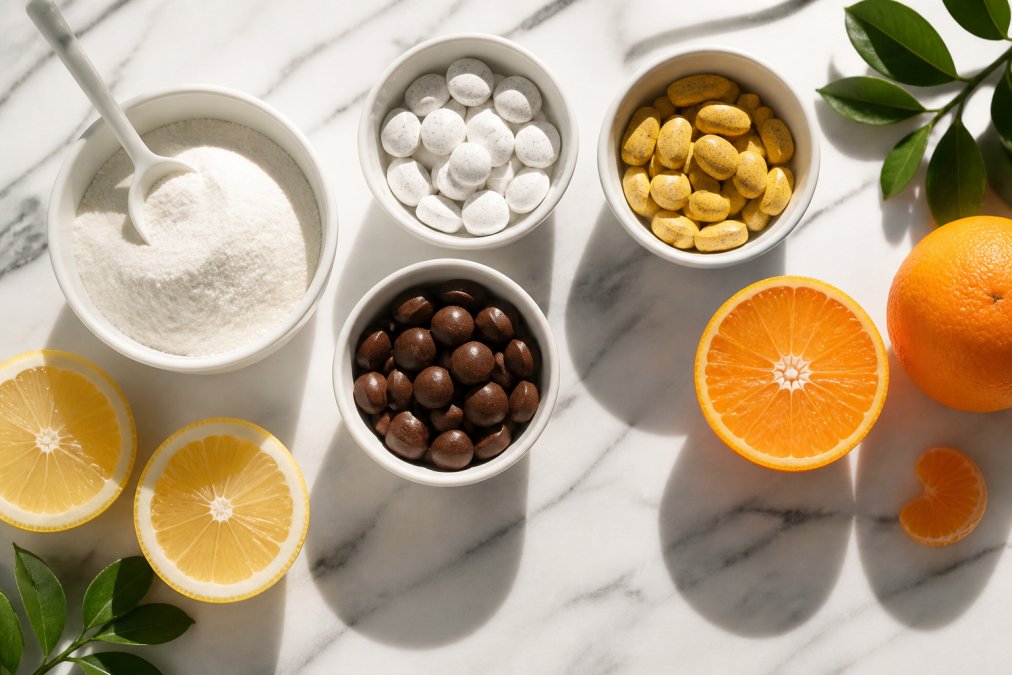
Hydration amplifies collagen's effects on nail flexibility. Collagen draws water into the nail matrix, improving elasticity. Aim for 2.7-3.7 liters of water daily.
The most practical approach: use a comprehensive collagen formula like Healthy Living Proteins' Multi Collagen Peptides & Colostrum that includes synergistic nutrients, then add a separate biotin supplement (2.5 mg daily) and ensure adequate vitamin C intake through diet or supplementation.
Brittle nails don't have to be permanent. The best collagen for brittle nails, hydrolyzed, multi-type formulas with colostrum and probiotics, works because it addresses both the structural protein deficit and absorption barriers. Healthy Living Proteins' Multi Collagen Peptides & Colostrum combines all five collagen types with synergistic nutrients your body needs to convert supplemental collagen into stronger, more resilient nails. Start with their formula, add a biotin supplement, and commit to 8 weeks of consistent daily use. You'll see visible improvement in nail texture and strength, supported by the 30-day money-back guarantee.
Frequently Asked Questions
Can collagen help brittle nails?
Yes. Brittle nails often result from low collagen levels, which weakens the nail matrix and plate. Collagen supplementation provides amino acids like glycine, proline, and hydroxyproline that your body uses to rebuild nail structure. Type I collagen specifically supports the structural integrity of nails. Most users report stronger, less peeling nails within 8-12 weeks of consistent supplementation, though results vary based on dosage, collagen type, and individual absorption.
What type of collagen is best for nails?
Type I collagen is most effective for nail health because it forms the primary structural component of the nail plate and nail matrix. Marine collagen (from fish) is Type I and absorbs faster due to smaller molecular weight (2,000-5,000 daltons). Bovine collagen also contains Type I and III, which supports elasticity. For nail-specific results, choose hydrolyzed collagen (bioactive collagen peptides) in powders or liquids, as the smaller peptide chains improve systemic absorption compared to non-hydrolyzed forms.
How long does it take for collagen to work on nails?
Most people notice visible improvements in nail strength and reduced peeling within 8-12 weeks of daily supplementation. The nail growth cycle takes about 3-6 months, so full results, including thicker, less brittle new growth, typically appear at the 12-16 week mark. Consistency matters: skipping doses delays results. Starting with 10-20g daily of hydrolyzed collagen peptides maximizes the timeline. Individual factors like age, diet quality, and baseline nutritional status affect speed.
What's the difference between biotin and collagen for nail health?
Biotin strengthens the nail keratin structure and improves nail thickness, while collagen rebuilds the underlying connective tissue and nail matrix. Biotin works best for preventing breakage; collagen addresses peeling and brittleness at the source. For optimal results, use both: collagen provides the structural amino acids, and biotin (2.5mg daily) enhances keratin production. Many premium supplements now combine them for this synergistic effect, like formulas that include both hydrolyzed collagen peptides and added biotin.
How much collagen should I take daily for nail growth?
Clinical research supports 10-20g of hydrolyzed collagen peptides daily for nail health. Most studies showing nail strength and growth improvements used 10g daily over 12+ weeks. If you weigh over 200 pounds or have severe brittleness, 15-20g daily may accelerate results. Take it consistently; collagen supplementation requires daily intake to maintain systemic absorption and support ongoing nail matrix renewal. Spread doses throughout the day if preferred, as the body absorbs collagen more efficiently in smaller amounts.
This article was written using GrandRanker