


Table of Contents
- Hydrolyzed Collagen vs Regular Collagen: What's the Difference?
- Why Whole Collagen Can't Be Absorbed Directly
- Collagen Absorption Rate: How Hydrolysis Changes the Game
- Collagen Bioavailability: What Science Says About Peptides
- Food vs. Supplements: Which Delivers More Usable Collagen?
- Maximizing Absorption: Vitamin C and Other Co-Factors
- How to Choose a Collagen Supplement That Your Body Will Absorb
- Conclusion: Pick Hydrolyzed Peptides for Measurable Results
- Frequently Asked Questions
Last Updated: September 6, 2026
Hydrolyzed Collagen vs Regular Collagen: What's the Difference?
Most collagen supplements look similar, but the difference determines whether your body actually uses what you drink. The core distinction comes down to molecular size and processing. Hydrolyzed collagen has undergone hydrolysis, where enzymes break the large protein into smaller peptide chains. Regular collagen, often sold as native collagen or gelatin, retains a much larger, fibrillar structure that your digestive system struggles to fragment.
This guide breaks down the science, absorption rates, and how to pick a supplement that delivers measurable results.
Why Whole Collagen Can't Be Absorbed Directly
Collagen in its natural state is a massive protein with a triple-helix structure. This fibrillar structure gives your skin, tendons, and connective tissue their tensile strength, but that same strength makes it nearly impossible for your gastrointestinal tract to process efficiently.
Your digestive enzymes can only work on the surface of a protein molecule. A whole collagen molecule is so large and tightly coiled that enzymatic breakdown happens slowly and incompletely, much of what you consume passes through without being broken down into absorbable amino acids.
Heat and acid can unwind the triple helix, but the resulting gelatin is still a large molecule. Your body must further fragment gelatin into smaller peptide chains before intestinal permeability allows absorption into the bloodstream.
Collagen Absorption Rate: How Hydrolysis Changes the Game
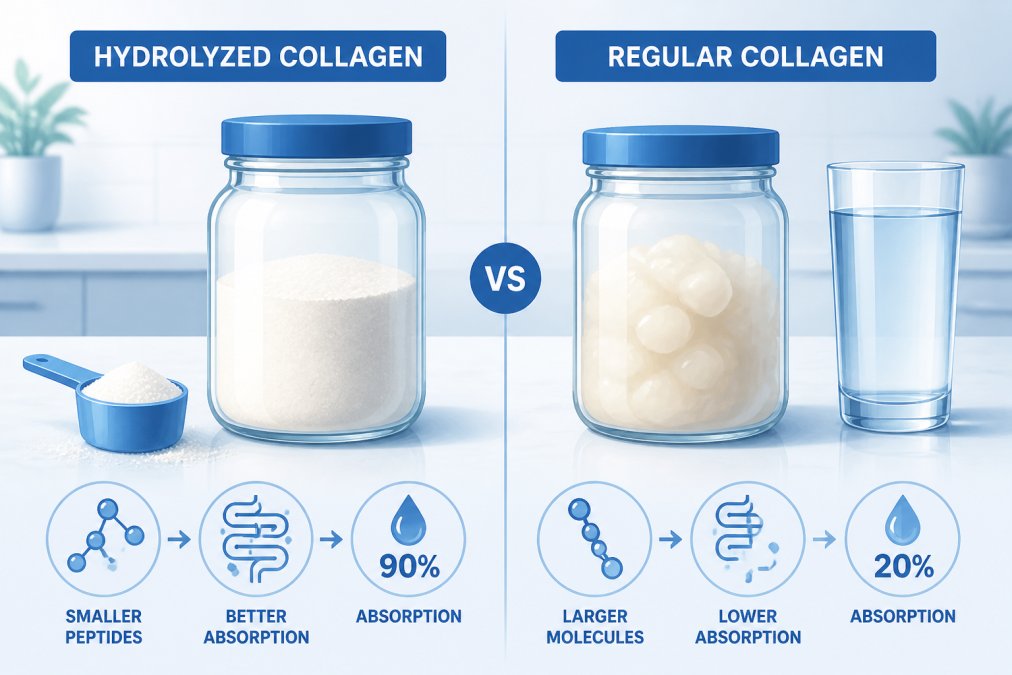
Hydrolysis pre-digests collagen for you. The process uses water and enzymes to cleave the long peptide chains into short fragments called collagen peptides or collagen hydrolysate, small enough that your gut can absorb them directly through the intestinal wall without extensive further breakdown.
The absorption rate difference is substantial. Hydrolyzed collagen peptides are water-soluble and disperse easily in liquid, reaching your intestinal lining intact and ready for uptake. Native collagen and gelatin require your body to do the fragmentation work, a slower, less complete process.
What matters most is whether those peptides survive digestion and enter your bloodstream. When they arrive in circulation, they can stimulate collagen synthesis in your dermal matrix and joint tissue. Low molecular weight is the key predictor of this bioavailability, which is why most clinical trials use hydrolyzed forms.
Collagen Bioavailability: What Science Says About Peptides
Bioavailability is not just about crossing the intestinal wall; it is about the fraction of the ingested dose that reaches systemic circulation and exerts a biological effect. For hydrolyzed collagen, the research is more nuanced than a simple 'high vs. low' comparison.
The Specific Peptides That Matter
Hydrolysis doesn't just make collagen smaller, it creates specific bioactive di- and tri-peptides. The most studied are prolyl-hydroxyproline (Pro-Hyp) and hydroxyprolyl-glycine (Hyp-Gly) . These short chains resist further breakdown by intestinal peptidases, allowing absorption intact via peptide transporters like PEPT1 in the small intestine. Once in the bloodstream, Pro-Hyp stimulates the proliferation of fibroblasts, the cells that produce new collagen in the dermis.
Regular collagen, by contrast, must first be denatured into gelatin and then cleaved into these same small peptides by your own digestive enzymes. This process is inefficient; a significant portion is broken down into free amino acids, which lack the signaling effects of intact di-peptides.
What the Clinical Evidence Actually Shows
Clinical trials typically use 2.5 to 10 grams of hydrolyzed collagen peptides per day to measure effects on skin elasticity or joint comfort, measuring blood levels of Pro-Hyp after ingestion (PubMed). Results consistently show a sharp peak in plasma concentration within 1 to 2 hours after oral intake, confirming the peptides survive digestion and enter circulation (PubMed).
However, it is important to distinguish between absorption and tissue incorporation. High blood levels do not automatically mean those amino acids are being laid down as new collagen in your knee cartilage or under-eye area. The body uses available amino acids based on demand and need, your body doesn't store a surplus of collagen-specific amino acids for later cosmetic use.
The 'Post-Absorption' Effect
A unique angle often missed is the hormetic or signaling effect of collagen peptides. Beyond serving as raw material, the presence of Pro-Hyp in the bloodstream appears to signal your body to ramp up its own production of collagen and other extracellular matrix components. This suggests that even a small amount of well-absorbed hydrolyzed collagen might trigger a disproportionately larger synthetic response than a larger amount of poorly absorbed regular collagen.
The Limits of Bioavailability Studies
Most bioavailability studies are conducted in controlled laboratory settings with fasted participants. Real-world conditions, such as consuming collagen with a high-protein meal, can alter absorption kinetics. Some research suggests that co-ingestion with other proteins may compete for the same peptide transporters, potentially reducing the peak concentration of collagen-specific peptides. This has direct implications for how you time your supplement intake.
Food vs. Supplements: Which Delivers More Usable Collagen?
Bone broth is the most common food source of collagen, and it is genuinely nutritious. But its collagen is mostly gelatin, not hydrolyzed peptides, a large protein requiring significant digestive work before absorption.
Supplement-based hydrolyzed collagen solves this by delivering pre-fragmented peptides. A scoop of powder mixed into your coffee or smoothie provides a concentrated dose of low molecular weight peptides that bypass the slowest part of digestion. For most adults over 25 looking to support skin elasticity or joint comfort, a supplement is the more reliable route to measurable intake.
There is also the question of consistency. Food sources vary widely in collagen content depending on preparation and sourcing. A supplement with a labeled gram amount gives you a predictable daily dose, important if you are tracking results over weeks and months.
| Collagen Source | Form | Absorption Efficiency | Best For |
|---|---|---|---|
| Bone broth | Gelatin | Low to moderate | General nutrition |
| Native collagen | Whole protein | Low | Limited practical use |
| Hydrolyzed peptides | Pre-digested fragments | High | Skin, hair, joint support |
Maximizing Absorption: Vitamin C and Other Co-Factors
Hydrolyzed collagen peptides absorb well on their own, but several co-factors can improve how much your body actually uses. Vitamin C is the most important, it is a required co-factor for the enzymes that synthesize new collagen (ods.od.nih.gov). Without adequate vitamin C, your body cannot convert absorbed amino acids into new collagen fibers efficiently.
Individual absorption variability is real. Factors like age, gut health, and the presence of other foods in your stomach all influence how much collagen you absorb. Taking collagen peptides on an empty stomach or with a light meal generally improves uptake compared to a heavy, protein-rich meal that competes for digestive capacity.
Gut health plays an outsized role in absorption. If your intestinal lining is compromised, even well-hydrolyzed peptides may not cross efficiently, which is why some formulations pair collagen with probiotics and colostrum to support the gut environment.
How to Choose a Collagen Supplement That Your Body Will Absorb
Choosing a supplement is not just about reading the front label. It requires understanding a few key variables that directly influence whether the product will actually deliver absorbable peptides.
Molecular Weight: The Number That Matters
Hydrolyzed collagen is not a single, uniform substance. The process can be controlled to produce peptides of varying average molecular weights, typically measured in Daltons (Da). The range is broad:
- High molecular weight (10,000-20,000 Da): Often labeled as 'collagen hydrolysate' but less processed. These larger chains are better than native collagen but still require some digestive work.
- Low molecular weight (2,000-5,000 Da): This is the range most clinical studies use. Peptides in this range are small enough for efficient absorption via PEPT1 transporters.
- Ultra-low molecular weight (under 1,000 Da): Some premium products claim to be 'micro-hydrolyzed' or 'nano-hydrolyzed.' While these are absorbed quickly, there is no strong evidence that they are more effective than the 2,000-5,000 Da range for stimulating collagen synthesis. In fact, extremely short peptides may be broken down into free amino acids in the bloodstream more rapidly, losing their signaling function.
A practical rule of thumb: look for a product that specifies a molecular weight range on the label or in the product specifications. If the brand does not disclose this, it is often a sign they are not targeting the optimal range for absorption.
Source: Marine vs. Bovine vs. Chicken
The source of the collagen affects its amino acid profile and peptide structure, which can influence absorption and efficacy.
- Marine collagen (fish): Typically has a smaller average particle size and a higher concentration of type I collagen. It is often cited as having faster absorption due to its lower denaturation temperature. However, it can have a slightly fishy taste and is not suitable for those with shellfish allergies.
- Bovine collagen (cows): The most common source. It provides type I and type III collagen, which are the primary types in skin and bone. It is generally well-tolerated and cost-effective.
- Chicken collagen: Primarily a source of type II collagen, which is the main type in cartilage. It is often used in products targeting joint health specifically.
There is no single 'best' source. The choice should depend on your primary goal: skin and hair (type I) versus joint support (type II).

The 'Multi-Collagen' Question
Many products now advertise 'multi-collagen' blends containing types I, II, III, V, and X. While this sounds comprehensive, it introduces a trade-off. A blend with type II collagen from chicken sternum will have a different peptide profile than a pure marine type I product. If your goal is skin elasticity, a high-dose type I product is likely more effective than a blend where type I is diluted. If your goal is overall joint and skin support, a multi-collagen may be more practical.
Third-Party Testing and Label Claims
Absorption is meaningless if the product does not contain what it claims. Look for supplements third-party tested by organizations like NSF International or USP for purity and label accuracy. These certifications are not about absorption, but they ensure that the '10 grams of hydrolyzed collagen' on the label is actually in the scoop.
The Cost-Per-Gram Calculation
A common mistake is comparing products by jar price. A $40 jar with 30 servings at 10 grams per serving is a different value proposition than a $40 jar with 15 servings at 5 grams. Calculate the cost per gram of actual collagen peptides to make an informed comparison. Prices typically range from $0.50 to $2.00 per 10-gram serving, depending on source and quality.
A Note on Sourcing and Sustainability
For marine collagen, look for products sourced from wild-caught fish rather than farmed, as the peptide profile can differ based on the fish's diet and environment. For bovine, 'grass-fed' is a marker of quality, but it does not directly impact absorption, it is more about the fatty acid profile of the source tissue and overall sustainability practices.
Conclusion: Pick Hydrolyzed Peptides for Measurable Results
The hydrolyzed collagen vs regular collagen absorption question has a clear answer. Hydrolyzed collagen peptides are the only form that reliably survives digestion, crosses your intestinal wall, and enters your bloodstream in a state your body can use. Regular collagen and gelatin require your body to do the heavy lifting, and much of the protein is wasted.
For anyone over 25 looking to support skin hydration, hair fullness, or joint mobility, choosing a hydrolyzed formula is the difference between spending money and seeing results. Healthy Living Proteins offers premium hydrolyzed collagen and colostrum supplements, expertly formulated for superior absorption and featuring all five collagen types, probiotics, and a 30-day money-back guarantee.
Get started with Healthy Living Proteins and give your body collagen it can actually absorb.
Frequently Asked Questions
Does hydrolyzed collagen work better than regular collagen?
Yes, for absorption. Hydrolyzed collagen undergoes enzymatic breakdown into smaller peptide chains, which allows it to dissolve in cold liquids and pass through the gastrointestinal tract more efficiently than native, unhydrolyzed collagen. Regular collagen has a fibrillar structure that is harder for the body to break down. When you consume hydrolyzed collagen peptides, they enter the bloodstream as dipeptides and tripeptides, which your tissues can use for collagen synthesis. This is why most clinical trials showing skin and joint benefits use hydrolyzed collagen rather than native forms.
What form of collagen is absorbed best by the body?
Hydrolyzed collagen peptides are absorbed best. The hydrolysis process fragments the large collagen molecule into short peptide chains with a low molecular weight, typically below 3,000 Daltons. These small peptides have high solubility, so they disperse easily in water or other beverages. Once ingested, they resist further breakdown in the gut and are taken up directly through the intestinal wall into the bloodstream. This gives hydrolyzed collagen a faster absorption rate and higher bioavailability compared to collagen in its native state, which must first be digested before any usable peptides are released.
What blocks the absorption of collagen?
Several factors can interfere with collagen absorption. A high intake of fiber at the same time as your supplement can slow gastric emptying, though it won't stop absorption entirely. Digestive conditions such as leaky gut syndrome or inflammatory bowel disease may reduce intestinal permeability and impair uptake. Tannins in tea and coffee can bind to proteins and reduce digestibility. Low stomach acid, common in older adults, also limits the initial breakdown of collagen. Taking your supplement between meals with vitamin C, rather than with a heavy, high-fiber meal, gives your digestive system the best chance to absorb the peptides efficiently.
How long does it take to see results from hydrolyzed collagen?
Most clinical trials measure outcomes at 8 to 12 weeks of daily use, but some people notice changes in nail strength and skin hydration within 4 weeks. The timeline depends on your age, baseline collagen levels, and consistent dosing. Hydrolyzed collagen peptides enter your bloodstream within hours of ingestion, but your body needs time to incorporate those amino acids into new collagen fibrils in the dermal matrix and connective tissue. Taking 10 to 11 grams daily without skipping days, and pairing it with vitamin C to support collagen synthesis, gives you the best chance of visible results within the standard 3-month window.