


Table of Contents
- What Your Body Actually Needs: The 5 Collagen Types Explained
- Why Single-Type Collagen Falls Short
- How Long Does It Take for Collagen to Work
- Best Practices for Taking Collagen Supplements
- Bioavailability: Why Hydrolyzed Collagen Matters
- Real Results: What Changes When You Commit
- Conclusion
Last Updated: August 15, 2026
What Your Body Actually Needs: The 5 Collagen Types Explained
Your body produces five distinct collagen types, each with a specific function. Most collagen supplements deliver only one or two, which is why taking all five matters, your skin, joints, muscles, and gut depend on different structural proteins to function optimally.
Type I collagen makes up roughly 90% of your body's collagen and forms the foundation of skin, hair, nails, tendons, and ligaments. When Type I declines after age 25, you notice thinning skin, brittle nails, and slower hair growth. Type II collagen is specialized for cartilage, keeping your joints cushioned and mobile. Without enough, joint stiffness becomes your daily reality. Type III collagen works alongside Type I to support skin elasticity and muscle tissue, maintaining firmness and hydration in your dermis. Type V and X collagens play supporting roles: Type V regulates collagen fiber diameter and supports bone, eyes, and teeth; Type X mineralizes bone tissue and supports cartilage repair. Together, all five create the structural scaffold that holds your body together.
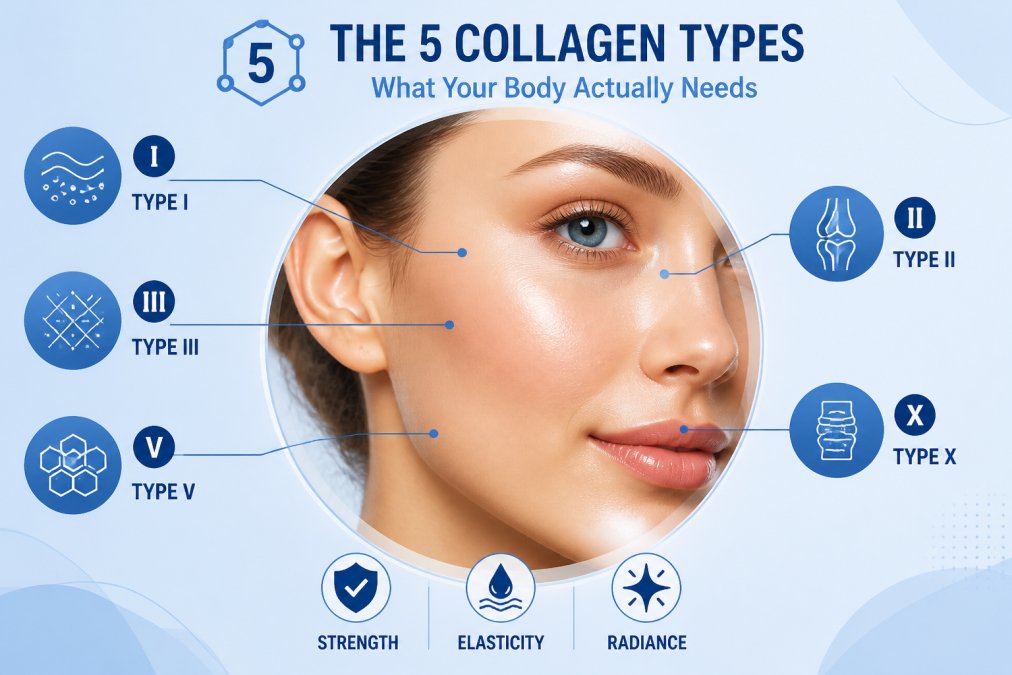
The problem is simple: single-type collagen supplements address only part of the picture. Your skin needs Type I and III together. Your joints need Type II. Your bones benefit from Type V and X. When you supplement with all five, you're giving your body the complete toolkit it actually uses.
Type I: Skin, Hair, and Nails
Type I collagen is the primary structural protein in your dermis, responsible for firmness and hydration. When it breaks down, fine lines appear, skin loses elasticity, and that youthful plumpness fades. Hair and nails depend on Type I as well, your hair shaft is anchored in the dermis by collagen, and as Type I declines, hair becomes thinner and more prone to breakage. Nails lose their flexibility and break easily; healthy nails should bend slightly without cracking, a property that comes from Type I collagen in the nail bed.
Hydrolyzed collagen peptides are broken-down chains of Type I collagen. Because the long collagen molecules have been broken into smaller amino acid chains, they absorb more easily in your digestive system. The amino acids, particularly glycine, proline, and hydroxyproline, are then used by your body to rebuild collagen in skin, hair, and nails.

Type II: Joint Cartilage and Mobility
Type II collagen is exclusively found in cartilage, forming the fibrillar structure that gives cartilage its shock-absorbing properties and allows joints to move smoothly. When Type II breaks down, cartilage thins, joints lose their cushioning, and movement becomes stiff or uncomfortable. This is why joint mobility declines with age, your knees, hips, shoulders, and spine all rely on Type II to maintain their range of motion.
Supplementing with Type II collagen in hydrolyzed form provides the amino acids your body needs to rebuild cartilage structure. Research consistently shows that people taking collagen peptides report improved comfort and mobility within weeks to months, though results vary by individual and consistency of use.
Type III: Muscle and Skin Elasticity
Type III collagen works in tandem with Type I to support skin elasticity and firmness. While Type I provides structure, Type III provides flexibility, the ability of skin to stretch and return to its original shape. It's also a major component of muscle tissue, blood vessels, and the connective tissue surrounding your organs. As Type III declines, skin loses that elastic "snap" and fine lines become more pronounced. In muscle tissue, Type III forms part of the extracellular matrix, which is why muscle quality depends on adequate collagen.
Type V and X: Supporting Roles
Type V collagen is found throughout your body in smaller amounts, in your eyes, bones, teeth, and connective tissue. It helps regulate the diameter and organization of collagen fibers and supports bone density and mineralization. Type X collagen is specialized for bone and cartilage, produced during bone formation and cartilage mineralization. Without adequate Type X, your bones lose density and strength, and cartilage repair slows. While Type V and X are needed in smaller quantities than Types I, II, and III, they're still essential for complete structural integrity.
Why Single-Type Collagen Falls Short
Most collagen supplements on the market contain only Type I or a combination of Types I and III. This is cheaper to produce and easier to market, but your body's needs are more complex. Someone taking a Type I-only supplement for joint discomfort will see skin improvements but miss the Type II their cartilage needs. Research shows that results improve when multiple types are present. Hydrolyzed collagen peptides containing all five types deliver a broader range of amino acids in the proportions your body actually uses. A formula like Healthy Living Proteins' Multi Collagen Peptides, which includes all five types in hydrolyzed form, gives your body the complete toolkit rather than forcing you to choose between skin, joints, or bones.
How Long Does It Take for Collagen to Work
For skin hydration and texture, many people report noticing changes within 4 to 8 weeks of daily supplementation. For hair and nail strength, expect 8 to 12 weeks, hair grows slowly, and nails grow about 3 millimeters per month. For joint mobility and comfort, results typically appear within 8 to 16 weeks, as cartilage rebuilds more slowly than skin cells turn over. Gut health and immune function improvements often appear within 2 to 4 weeks if you're using a formula that includes colostrum and probiotics.
The key variable is consistency. Daily supplementation works; sporadic use doesn't. Your body is constantly breaking down and rebuilding collagen. If you supply the amino acids daily, your body can maintain and rebuild.
Best Practices for Taking Collagen Supplements
Dosage and Timing
Most effective collagen supplements contain 10 to 20 grams of hydrolyzed collagen peptides per serving. Healthy Living Proteins' Multi Collagen Peptides delivers 11 grams of all five collagen types per serving, which falls squarely in the effective range. Timing matters less than consistency, but taking collagen with a meal that includes vitamin C and protein enhances absorption. Vitamin C is a cofactor for collagen synthesis, and protein provides additional amino acids that work synergistically with collagen peptides. Many people mix collagen powder into their morning coffee, tea, or smoothie.

Pairing Collagen With Synergistic Ingredients
Collagen works better when paired with ingredients that support collagen synthesis and absorption. Vitamin C stabilizes collagen and helps your body cross-link new collagen fibers. Probiotics support gut health and improve amino acid absorption. Colostrum contains growth factors and immunoglobulins that support a healthy gut lining, making nutrient absorption more efficient. Formulas that combine all five collagens with probiotics and colostrum deliver better results than collagen alone. Hydration also matters, drinking 8 to 10 glasses of water daily ensures your body has the fluid it needs to transport amino acids and synthesize new collagen.
Consistency Over Perfection
The biggest mistake people make with collagen supplements is treating them as a short-term fix. Collagen supplementation works when you're consistent over weeks and months. The best supplement is the one you'll actually take every day. Hydrolyzed collagen peptides are flavorless and mix easily into any beverage, which makes consistency easier.
Bioavailability: Why Hydrolyzed Collagen Matters
Collagen is a massive protein molecule. Non-hydrolyzed collagen must be broken down by your digestive system before absorption, which is inefficient. Hydrolyzed collagen has already been broken down into smaller peptide chains (typically 2,000 to 5,000 Daltons in molecular weight), which your digestive system can absorb directly into your bloodstream. This is why hydrolyzed collagen peptides have superior bioavailability.

This is why taking all five collagens matters most when those collagens are hydrolyzed. Healthy Living Proteins' formulas use hydrolyzed collagen peptides sourced from grass-fed bovine, wild-caught marine, and free-range chicken.
Real Results: What Changes When You Commit
When you take a complete collagen supplement consistently for 12 weeks or more, specific changes become visible.

Skin becomes noticeably smoother and more hydrated. Fine lines appear less pronounced. Hair becomes thicker and stronger, with less shedding and better texture. Nails stop breaking and peeling, becoming flexible instead of brittle. Joint comfort and mobility improve, with decreased stiffness and increased range of motion. Digestion settles, with reduced bloating and discomfort. Energy and recovery improve, with less soreness after workouts and faster recovery from activity. These changes compound, after 12 weeks, you'll look and feel noticeably different.
Conclusion
Your body needs all five collagens to function optimally. Type I supports skin, hair, and nails. Type II maintains joint cartilage and mobility. Type III provides elasticity and muscle structure. Type V and X support bone density and overall structural integrity. Single-type collagen supplements address only part of your needs.
According to research on collagen supplementation from the Journal of Sports Medicine and Physical Fitness, complete collagen profiles deliver broader benefits than isolated types. When you supplement with all five collagens in hydrolyzed form, your body has the complete toolkit it needs to rebuild skin, joints, muscle, and bone.
Healthy Living Proteins' Multi Collagen Peptides contains all five collagen types in hydrolyzed form, sourced from grass-fed bovine, wild-caught marine, and free-range chicken. At $44.99 per container, it delivers 11 grams of complete collagen per serving. The Multi Collagen Peptides & Colostrum formula adds colostrum and probiotics for enhanced absorption and gut health support at $49.99. For athletes, the Multi Collagen Peptides & Creatine combines all five collagens with 5 grams of creatine monohydrate at $59.99.
All Healthy Living Proteins products come with a 30-day money-back guarantee. Start with whichever formula aligns with your primary health goal, commit to 12 weeks of daily supplementation, and track the specific changes you want to see. Most people see measurable results by week 8, with dramatic changes by week 12. Get started with Healthy Living Proteins and experience the difference that complete collagen supplementation delivers.
| Collagen Type | Primary Function | Where It's Found | What Happens When It Declines |
|---|---|---|---|
| Type I | Skin structure, hair strength, nail integrity | Skin, hair, nails, tendons, ligaments | Fine lines, brittle nails, thin hair, sagging skin |
| Type II | Cartilage cushioning, joint mobility | Cartilage, joint tissue | Joint stiffness, reduced mobility, discomfort |
| Type III | Skin elasticity, muscle structure | Skin, muscles, blood vessels | Loss of elasticity, muscle weakness, poor recovery |
| Type V | Fiber organization, bone density, eye health | Bones, eyes, connective tissue | Weak collagen structure, reduced bone density |
| Type X | Bone mineralization, cartilage repair | Bone, cartilage | Slow bone healing, weak cartilage repair |
Frequently Asked Questions
Do you need to take all 5 types of collagen?
Your body uses all five collagen types for different functions. Type I supports skin elasticity and hair strength, Type II maintains joint cartilage, Type III contributes to muscle and skin structure, while Types V and X play supporting roles in connective tissue. Single-type supplements address only one area, leaving gaps. Taking all five ensures comprehensive support for skin, joints, gut, and immunity simultaneously, which is why many see faster, more noticeable results across multiple areas.
How long does it take to see results from collagen supplements?
Most people notice initial changes in skin hydration and energy within 2-4 weeks. Hair and nail improvements typically appear around 6-8 weeks, as these grow slowly. Joint mobility and flexibility improvements often take 8-12 weeks of consistent supplementation. Gut health benefits may be felt within 3-4 weeks. Results depend on dosage, consistency, age, and overall health. The key is taking it daily without breaks, sporadic use delays results significantly.
What makes hydrolyzed collagen better than regular collagen?
Hydrolyzed collagen is broken down into smaller peptides through enzymatic processing, dramatically improving absorption in your digestive system. Regular collagen is a large protein molecule that your body struggles to break down and utilize efficiently. Hydrolyzed collagen peptides are absorbed quickly into the bloodstream, allowing amino acids like glycine and proline to reach your skin, joints, and gut lining where they're needed. This bioavailability difference is why hydrolyzed forms deliver visible results faster.
Can I just take collagen supplements instead of eating collagen-rich foods?
Supplements and dietary sources serve different purposes. Bone broth and collagen-rich foods provide collagen alongside other nutrients, but the collagen itself isn't efficiently absorbed unless hydrolyzed. Hydrolyzed collagen supplements are specifically engineered for bioavailability, delivering amino acids directly to tissues that need repair. Most people benefit from both: eating collagen-rich foods for overall nutrition while supplementing with hydrolyzed peptides for targeted, measurable results in skin, joints, and gut health.
This article was written using GrandRanker