


Table of Contents
- What Happens to Collagen After 25
- Early Signs of Collagen Deficiency
- How to Stop Hair Thinning and Support Collagen Naturally
- Benefits of Hydrolyzed Collagen Supplements for Collagen Restoration
- Collagen Banking for 20-Somethings: Start Before Decline Begins
- Lifestyle Factors That Accelerate Collagen Loss
- Conclusion
Last Updated: August 26, 2026
What Happens to Collagen After 25
Your skin starts changing the moment you turn 25. Not dramatically, not overnight, but measurably. This is when collagen deficiency after 25 becomes a real concern for most people, even if you don't see it yet.
Collagen is the protein that holds your skin together. It's the scaffolding in your dermal matrix, the stuff that keeps everything firm, elastic, and plump. Your body produces less of it every year after 25, roughly 1% less annually (peer-reviewed research). By the time you hit 30, you've already lost about 5% of your collagen production capacity (peer-reviewed research). By 40, it's closer to 15-20%. The decline accelerates, and unlike other things that fade with age, you can't just get more collagen by eating better alone.
The real problem isn't that collagen disappears instantly. It's that the rate of breakdown starts outpacing the rate of production. Your fibroblasts (the cells that manufacture collagen) slow down. Environmental damage piles up. Sun exposure, stress, poor sleep, and oxidative stress all attack the collagen you do have. The result is a compounding deficit that shows up first in your skin, then in your joints, hair, and nails.
At Healthy Living Proteins, we've worked with thousands of people noticing these early signs. Most assume they need expensive treatments or invasive procedures. The truth is simpler: catching collagen loss early and supporting your body's natural production with the right approach, better nutrition, lifestyle changes, and targeted supplementation, makes a measurable difference.
Here's what you need to know about collagen deficiency after 25 and what you can actually do about it.
Early Signs of Collagen Deficiency
The early warning signs are subtle enough that most people miss them until they're staring at a photo from five years ago and wondering what changed.
Skin Changes and Loss of Elasticity
Fine lines appear first, usually around the eyes and mouth. Not wrinkles yet, fine lines that disappear when you stretch your skin but stay visible when you relax. This happens because the dermal matrix is thinning. Collagen gives skin its bounce-back ability. When you lose it, your skin loses elasticity.
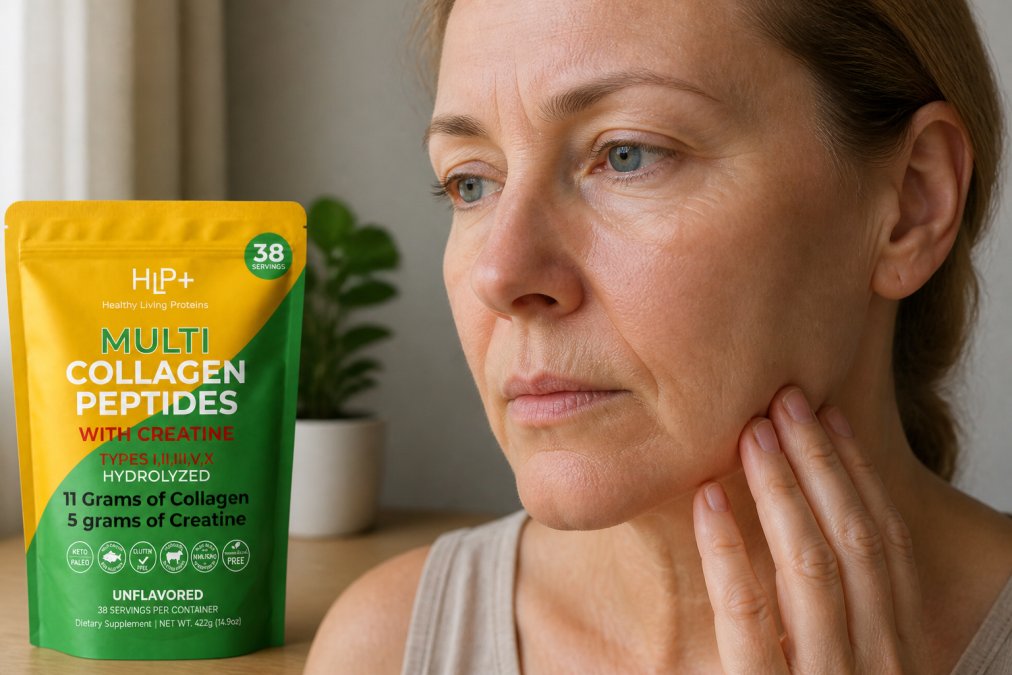
Dullness comes next. Your skin looks less radiant, less hydrated, even when you're drinking plenty of water. This is trans-epidermal water loss, your skin barrier isn't holding moisture the way it used to. Collagen supports the skin barrier function. Without it, hydration escapes faster.
Sagging is the third stage. Your skin starts to look less tight, particularly along the jawline and under the eyes. This is subcutaneous fat loss combined with reduced skin laxity. The collagen that was keeping everything taut is gone, so gravity wins. Pores also look larger because they're no longer supported by the collagen around them.
Some people notice their skin texture changes, it becomes rougher, less smooth. This is partly dead skin cell buildup (your skin cell turnover slows with age) and partly loss of the smooth collagen structure underneath.
Hair Thinning and Brittle Nails
Hair thinning often surprises people because they don't immediately connect it to collagen loss. But collagen is a structural protein. Your hair follicles depend on collagen in the dermal layer for strength and resilience. When collagen declines, hair becomes thinner, breaks more easily, and grows more slowly.
You'll notice this when you wash your hair, more strands in the drain. Your hair might look less full, less voluminous. It might not hold a style the way it used to. Some people experience hair loss in patches, though that's usually a sign of more advanced deficiency or other underlying factors.
Nails follow the same pattern. They become brittle, peel easily, break at the slightest pressure. They might also become thinner and more flexible. Collagen in the nail bed supports the hard keratin structure. Without it, nails become weak.
Joint Stiffness and Reduced Mobility
This is the sign most people don't attribute to collagen loss because they think of collagen as a skin thing. But type II collagen is the primary structural component of cartilage. When collagen declines, your cartilage degrades. Your joints feel stiffer, especially in the morning or after sitting for a while.
You might notice reduced range of motion. Movements that were easy five years ago now feel restricted. Climbing stairs, squatting, reaching overhead, these become slightly uncomfortable or require more effort. Some people experience joint discomfort that comes and goes depending on activity level or weather.
This isn't arthritis yet, but it's the early stage of joint health decline. The difference between someone who addresses this at 28 and someone who waits until 45 is significant.
How to Stop Hair Thinning and Support Collagen Naturally
Hair thinning from collagen loss requires a two-pronged approach: support your body's collagen production and protect the collagen you have.
Start with diet. Your body needs specific amino acids to manufacture collagen, primarily glycine, proline, and hydroxyproline. These are abundant in bone broth, but also in gelatin, egg whites, and citrus fruits (vitamin C is essential for collagen synthesis). If you eat meat with skin, connective tissue, or bone-in cuts, you're getting collagen directly. Most modern diets skip these parts.
Add vitamin C. Your fibroblasts cannot synthesize collagen without it. Aim for 500-1,000 mg daily from food or supplement form (the NIH). Citrus, berries, bell peppers, and leafy greens are solid sources.
Hydration matters. Collagen needs water to function properly. Dehydrated skin looks worse, and your body can't manufacture collagen efficiently if you're not drinking enough water. Aim for half your body weight in ounces daily (if you weigh 150 pounds, that's 75 ounces).
Reduce sugar and processed foods. Excess sugar causes glycation, a process where sugar molecules bond to collagen and cross-link it, making it stiff and dysfunctional. This accelerates visible aging. Cut back on refined carbohydrates and added sugars.
Sleep seven to nine hours nightly. Collagen synthesis happens primarily during deep sleep. Your growth hormone peaks during sleep, which triggers collagen production. Poor sleep directly impairs your body's ability to rebuild collagen.
Manage stress. Chronic stress elevates cortisol, which breaks down collagen faster than your body can replace it. Stress also impairs sleep and digestion, both critical for collagen health. Even basic stress management, 20 minutes of walking, meditation, or time in nature, makes a measurable difference.
For hair specifically, scalp health matters. Massage your scalp for two minutes daily to increase blood flow to hair follicles. This delivers more oxygen and nutrients to the follicles and supports collagen in the dermal layer beneath.
Benefits of Hydrolyzed Collagen Supplements for Collagen Restoration
Dietary collagen alone often isn't enough once you're past 25. Your digestive system breaks down whole collagen molecules into amino acids before absorption. You lose the specific amino acid ratios your body needs for collagen synthesis.
Hydrolyzed collagen (also called collagen peptides) solves this problem. The collagen is broken down into smaller peptide chains before you consume it, so your digestive system absorbs them more efficiently. This means your body gets the exact amino acids it needs in the proportions it needs them.
The science is straightforward: hydrolyzed collagen peptides are absorbed at higher rates than whole collagen. Your intestines can absorb these peptides intact, which means they reach your bloodstream and accumulate in your skin, joints, and connective tissue more effectively than amino acids from other protein sources.
Most quality collagen supplements contain multiple types. Your body uses five different collagen types, and each serves a different purpose. Type I and III are in your skin. Type II is in your cartilage. Type V is in hair and nails. Type X supports bone. A multi-type supplement like Healthy Living Proteins' Multi Collagen Peptides covers all five, which means you're supporting skin, joints, hair, nails, and bone health simultaneously rather than targeting just one area.
The addition of colostrum and probiotics amplifies the benefits. Colostrum contains growth factors and immunoglobulins that support gut health, which improves nutrient absorption. Better absorption means the collagen peptides you're consuming actually get used by your body. Probiotics support the gut microbiome, which influences skin health, immune function, and inflammation levels, all factors that impact how quickly your body can rebuild collagen.
Expect to notice changes in 4-8 weeks. Skin hydration improves first (usually within 2-3 weeks), followed by hair and nail strength, then joint mobility. Collagen takes time to accumulate in your tissues, so patience matters. Most people see noticeable improvements in skin texture, firmness, and hair quality by week 6-8 of consistent supplementation.
Collagen Banking for 20-Somethings: Start Before Decline Begins
If you're in your 20s reading this, you have an advantage most people don't: you can prevent the decline before it starts. This is called collagen banking.
The concept is simple: your collagen levels at 25 are largely determined by how well you've supported collagen production in your teens and 20s. If you build a strong collagen foundation early, you start your decline from a higher baseline. Someone who banks collagen in their 20s will have noticeably better skin, hair, and joint health at 40 than someone who ignored it.
Start with the lifestyle factors: sleep, stress management, sun protection, hydration, and a diet rich in vitamin C and amino acids. These are free or nearly free. They also prevent other damage, sun damage, for example, is cumulative and irreversible. Preventing photoaging now means you won't be fighting it in your 40s.
Add a collagen supplement early. You don't need to wait until you see signs of deficiency. By the time visible signs appear, you've already lost significant collagen. Supplementing in your 20s means you're maintaining higher collagen levels throughout your 30s and 40s. The difference between starting at 22 versus starting at 35 is dramatic.
Consider collagen banking an investment in your future appearance and mobility. A 25-year-old who starts supplementing now will have visibly better skin, stronger hair and nails, and more mobile joints at 50 than a 25-year-old who waits until they notice problems.
Lifestyle Factors That Accelerate Collagen Loss
Some lifestyle factors actively destroy collagen. Understanding these helps you avoid unnecessary damage.

Sun exposure is the biggest culprit. UV radiation generates free radicals that attack collagen directly through a process called photoaging. Sun damage is cumulative and permanent. Every unprotected minute in the sun degrades collagen in your skin. This is why people who've spent decades in the sun look significantly older than their age. Use broad-spectrum SPF 30+ daily, even on cloudy days. UV rays penetrate clouds.
Smoking accelerates collagen loss dramatically. Tobacco smoke contains thousands of chemicals that generate oxidative stress and directly impair collagen synthesis. Smokers show visible signs of aging 10-15 years earlier than non-smokers. If you smoke, quitting is the single most impactful change you can make for your skin and overall health.
Alcohol dehydrates your skin and impairs collagen synthesis. Excessive alcohol consumption also increases inflammation and oxidative stress, both of which break down collagen. Moderate consumption (one drink daily for women, two for men) is generally fine, but heavy drinking accelerates aging visibly.
Poor diet accelerates collagen loss. High sugar intake causes glycation. Processed foods are usually high in omega-6 fatty acids and low in omega-3s, which promotes inflammation. Inflammation breaks down collagen. A diet high in whole foods, healthy fats, and antioxidants supports collagen preservation.
Sleep deprivation impairs collagen synthesis. Your body manufactures most of its collagen during deep sleep. Chronic sleep loss means your fibroblasts never get the signal to produce collagen. You also accumulate more oxidative stress without adequate sleep, which actively damages the collagen you have.
Stress elevates cortisol, which breaks down collagen and impairs synthesis. Chronic stress also impairs sleep and digestion, creating a cascade of collagen-damaging effects. Even moderate stress management reduces cortisol and supports collagen preservation.
Sedentary lifestyle weakens joints and accelerates collagen loss in cartilage. Movement stimulates fibroblasts in connective tissue, signaling them to produce collagen. People who exercise regularly have stronger joints and better skin elasticity than sedentary people of the same age.
Environmental pollution generates oxidative stress. Particulate matter and chemical pollutants in air can penetrate skin and generate free radicals that attack collagen. While you can't control air quality, antioxidant-rich foods and supplements help neutralize this damage.
Conclusion
Collagen deficiency after 25 isn't inevitable. It's the natural result of aging combined with lifestyle choices. The people who look best at 40, 50, and beyond aren't the ones with perfect genetics, they're the ones who started supporting their collagen early and consistently.
The combination of lifestyle changes (sleep, stress management, sun protection, better diet) plus targeted supplementation delivers measurable results. Healthy Living Proteins' Multi Collagen Peptides with all five collagen types, plus colostrum and probiotics for superior absorption, gives your body exactly what it needs to maintain skin elasticity, support hair and nail strength, and preserve joint mobility. With a 30-day money-back guarantee, there's no risk in testing whether it works for you. Start now, and you'll notice the difference by week 6.

Frequently Asked Questions
Q: Does collagen production naturally slow down at age 25?
A: Yes. Collagen synthesis begins declining in the mid-20s, with most people experiencing a 1% annual decrease after age 25. This slowdown accelerates further after 40. The dermal matrix thins as fibroblasts produce less type I and III collagen, the primary structural proteins in skin. This natural decline is why preventative action, through diet, lifestyle, and supplementation, matters most in your 20s and 30s, before visible signs appear.
Q: What are the first signs of low collagen?
A: Early indicators include fine lines around the eyes and mouth, loss of skin elasticity (skin takes longer to bounce back when pinched), increased dryness, dull complexion, and subtle sagging in the jawline. Hair may feel thinner or more fragile, and nails might become softer or more prone to breaking. Joint stiffness after sitting or sleeping is another common early sign. These changes often appear gradually, which is why many people don't notice them until they're already pronounced.
Q: How do hydrolyzed collagen supplements work, and how long before I see results?
A: Hydrolyzed collagen is broken into smaller peptides, improving absorption in the digestive tract. Once absorbed, amino acids like glycine, proline, and hydroxyproline support fibroblast function and collagen synthesis in the dermal matrix. Most users report noticeable improvements in skin hydration and hair texture within 4-8 weeks of consistent use, though joint comfort and skin firmness may take 8-12 weeks. Results depend on dosage, overall diet, hydration, and sun protection habits.
Q: Can collagen loss be reversed once it starts?
A: Complete reversal isn't possible, but you can slow decline and improve appearance. Hydrolyzed collagen supplements, combined with vitamin C, protective skincare, and sun avoidance, support new collagen synthesis and strengthen the existing dermal matrix. Professional treatments like microneedling and laser therapy stimulate fibroblasts to produce fresh collagen. The key is starting early, preventing loss in your 20s and 30s is far more effective than trying to rebuild significantly depleted collagen later.
This article was written using GrandRanker